Introduction to Using NSSE in Accreditation: Accreditation Toolkits
One of the most common institutional uses of NSSE data is for accreditation. In fact, NSSE schools report that accrediting agencies are the primary external group with which they share NSSE results.
NSSE results can be used in all components of the accreditation process: self-studies, quality improvement initiatives, discussions during visits by the team of peer evaluators, and in response to an accrediting body’s request for improvement or additional evidence of educational effectiveness.
NSSE results are primarily used for institution accreditation, but student engagement results can also apply to specialized and professional accreditation efforts, including ABET, AACSB, CAEP, AAQEP and CCNE. Contact NSSE for suggestions related to these bodies.
NSSE's Accreditation Toolkits include guidelines that suggest ways to map survey items to accreditation standards, timelines to help institutions decide when and how often to collect student engagement data, and examples of how other institutions in each region have used NSSE in their accreditation efforts.
Toolkits mapped to standards currently in effect are available as downloadable resources (toolkits mapped to older standards are available by request to NSSE).
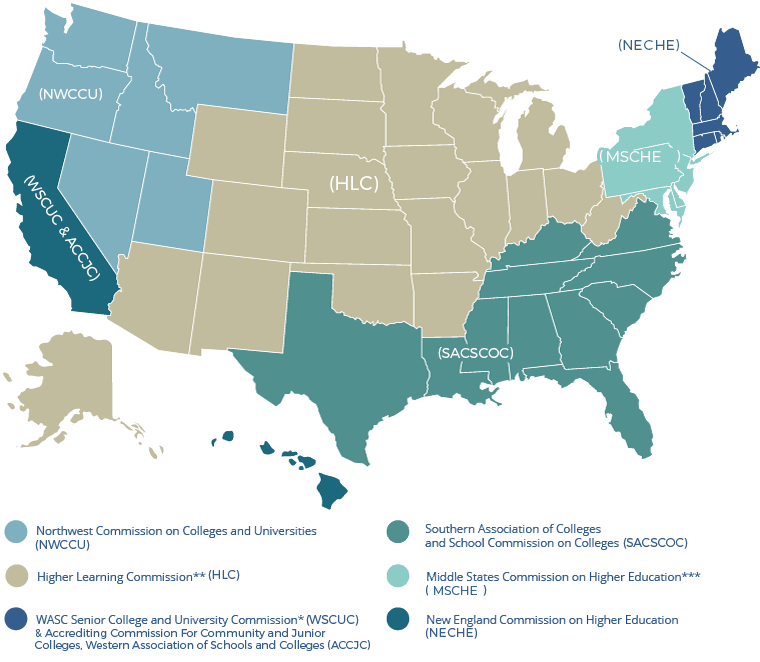
Council for Higher Education Accreditation (CHEA) Map of Accrediting Commissions
NSSE Accreditation Toolkits
Download the desired Accreditation Toolkit below, or continue downward for on-site versions.
Mapping NSSE Items to Accreditation Standards and Criteria
A key resource in the NSSE Accreditation Toolkits is the accreditation body specific discussion of requirements and updates and the tables mapping NSSE items to standards and criteria.
A successful accreditation plan is authentic to each institution. An important step in developing any accreditation plan, however, is identifying the existing evaluation practices and the evidence from them that can be linked to accreditation standards, commitments, and/or criteria. To assist with this connection, a team of NSSE staff members reviewed accreditation standards for each accreditation organization and mapped NSSE survey items to those standards that we thought closely corresponded. Our hope is that this alignment encourages institutions to consider various ways to integrate NSSE data into accreditation processes, beyond simply mentioning NSSE as an element in its systematic assessment activities. NSSE updates materials to correspond with revised accreditation standards.
View NSSE item maps to accreditation standards by opening specific accreditation body documents:
Mapping NSSE Items to Higher Learning Commission (HLC) Criteria
A successful accreditation plan is authentic to each institution. An important step in developing any accreditation plan, however, is identifying the existing evaluation practices and the evidence from them that can be linked to accreditation standards, commitments, and/or criteria.
A team of NSSE staff members reviewed accreditation standards for each accreditation organization and mapped NSSE survey items to those standards that we thought closely corresponded. Our hope is that this alignment encourages institutions to consider various ways to integrate NSSE data into accreditation processes, beyond simply mentioning NSSE as an element in its systematic assessment activities.
This toolkit, including the table on pages 6 and 7, “NSSE 2022-25 Survey Items Mapped to HLC Criteria”, is not intended as a strict formula for relating NSSE results to accreditation standards but, rather, as a stimulus to think more broadly about how these data can provide evidence to support specific standards. NSSE data can be used as a guide when designing an assessment plan or, retroactively, when looking back to assess the impact of a new program or initiative. Looking forward, institutions can look at their NSSE results to think critically and shape the new program. Looking back, if an institution has participated in NSSE two or more times leading up to reaffirmation, it can also use NSSE data longitudinally to reflect on criteria. By looking across data from two or three NSSE administrations, institutions can reflect on quality and improvement initiatives and their impact over time on seniors, first-years, or subgroups (e.g., veterans, commuter students). NSSE findings can support and document a range of institutional improvement efforts but will be most meaningful when coupled with other student outcome measures for your campus.
NSSE and HLC Criteria
The HLC Board of Trustees adopted revisions to the Criteria for Accreditation and placed new criteria in effect September 1, 2025. The revisions include a new “Institutional Mission” section reflecting the importance of mission as a lens for meeting the Criteria. The revisions add clarity by eliminating subcomponents and integrating some of the concepts into revised Criteria and/or Assumed Practices. The revisions consolidated criteria for teaching and learning into 1 criterion. Several of the modified criteria are particularly relevant to student engagement results and are well-represented in the mapping, and emphasize NSSE’s benchmarking opportunities to peer institutions.
Criterion 1. Institutional Mission
NSSE results can help demonstrate alignment with an institutions’ articulated mission and guide the mission specification. Notably, 1.C. “The institution provides opportunities for civic engagement in a diverse, multicultural society and globally connected world, as appropriate within its mission and for the constituencies it serves.” maps to NSSE Engagement Indicators including Reflective & Integrative Learning and Discussions with Diverse Others, and several items.
Criterion 3. Teaching and Learning for Student Success
Many NSSE items offer data points as evidence that the institution provides quality education, learning environments and support services, inclusive of Core Components 3.B., 3.C., 3.D., 3.E., 3.F., and 3.G. NSSE results broadly represent institutions’ commitment to continuous improvement for student success outcomes in 3.G. Regular participation in NSSE is an important commitment to the practice of routine assessment and program review and action on findings and to build into processes for assessment and continuous improvement in academic and co-curricular learning. NSSE’s peer comparison groups make it possible to benchmark peer institutions as well as examine student populations and student success outcomes.
Criterion 4. Sustainability: Institutional Effectiveness, Resources and Planning
Participation in NSSE is related to Criterion 4, and in particular 4.C., which focuses on planning for quality improvement, including a reliance on data, and student learning assessment.
Criteria for Accreditation in Effect
Criteria for Accreditation (2025 edition). This mapping reflects the latest revision of the Higher Learning Commission’s (HLC) Criteria for Accreditation., adopted by the HLC Board of Trustees effective September 1, 2025.
NSSE Demographic Items, Consortium Questions, and Topical Modules
In addition to the survey items shown in the following table, the updated NSSE survey contains demographic items, Questions 20–39, that may be of value for examining practices by student subpopulation and for exploring the influence of institutional conditions and student identities such as on-campus residence and student status including first-generation, student-athlete, or veteran. Institutions participating in a consortium may also have results relevant to accreditation, including assessment of mission effectiveness. New customization options on the updated survey include Topical Modules—short sets of questions on topics such as academic advising, writing, and technology use. Responses to these items may help with the assessment of practices and provide evidence of quality including, for example, quality of advising, civic engagement and relationships between writing and learning. Additional modules will be added over time.
NSSE 2022-25 Survey Items Mapped to HLC Criteria and Core Components
This mapping reflects the HLC Criteria for Accreditation, revised and in effect September 2025; *Note NSSE participation and results broadly relate to Criterion 4
NSSE 2022-25 Survey Items
Criteria/Core Components*
1.
During the current school year, about how often have you done the following?
a.
Asked questions or contributed to course discussions in other ways
3.B,3.D
b.
Asked another student to help you understand course material
3.B, 3.D
c.
Explained course material to one or more students
3.B, 3.D
d.
Prepared for exams by discussing or working through course material with other students
3.B, 3.D
e.
Worked with other students on course projects or assignments
3.B, 3.D
f.
Given a course presentation
3.B
2.
During the current school year, about how often have you done the following?
a.
Combined ideas from different courses when completing assignments
3.B, 3.D
b.
Connected your learning to societal problems or issues
1.C, 3.B
c.
Included diverse perspectives (political, religious, racial/ethnic, gender, etc.) in course discussions or assignments
1.C, 3.B
d.
Examined the strengths and weaknesses of your own views on a topic or issue
1.C, 3.B
e.
Tried to better understand someone else’s views by imagining how an issue looks from his or her perspective
3.B
f.
Learned something that changed the way you understand an issue or concept
3.B
g.
Connected ideas from your courses to your prior experiences and knowledge
3.B
3.
During the current school year, about how often have you done the following?
a.
Talked about career plans with a faculty member
1.C, 3.C, 3.D
b.
Worked with a faculty member on activities other than coursework (committees, student groups, etc.)
3.B, 3.C
c.
Discussed course topics, ideas, or concepts with a faculty member outside of class
3.B, 3.C
d.
Discussed your academic performance with a faculty member
3.C
4.
During the current school year, how much has your coursework emphasized the following?
a.
Memorizing course material
3.A, 3.B
b.
Applying facts, theories, or methods to practical problems or new situations
3.A, 3.B
c.
Analyzing an idea, experience, or line of reasoning in depth by examining its parts
3.A, 3.B
d.
Evaluating a point of view, decision, or information source
3.A, 3.B
e.
Forming a new idea or understanding from various pieces of information
3.A, 3.B
5.
During the current school year, to what extent have your instructors done the following?
a.
Clearly explained course goals and requirements
3.C, 3.D
b.
Taught course sessions in an organized way
3.C, 3.D
c.
Used examples or illustrations to explain difficult points
3.C, 3.D
d.
Provided feedback on a draft or work in progress
2.E, 3.C, 3.D
e.
Provided prompt and detailed feedback on tests or completed assignments
2.E, 3.C, 3.D
f.
Explained in advance the criteria for successfully completing your assignments
3.C, 3.D
g.
Reviewed and summarized key ideas or concepts
3.C, 3.D
h.
Taught in a way that aligns with how you prefer to learn
3.C, 3.D
i.
Enabled you to demonstrate your learning through quizzes, assignments, and other activities
3.C, 3.D
6.
During the current school year, about how often have you done the following?
a.
Reached conclusions based on your own analysis of numerical information (numbers, graphs, statistics, etc.)
3.A, 3.B
b.
Used numerical information to examine a real-world problem or issue (unemployment, climate change, public health, etc.)
3.A, 3.B
c.
Evaluated what others have concluded from numerical information
3.A, 3.B
7.
During the current school year, about how many papers, reports, or other writing tasks of the following length have you been assigned? (Include those not yet completed.)
a.
Up to 5 pages
3.A, 3.B
b.
Between 6 and 10 pages
3.A, 3.B
c.
11 pages or more
3.A, 3.B
8.
During the current school year, about how often have you had discussions with people from the following groups?
a.
People of a race or ethnicity other than your own
1.C, 3.B
b.
People from an economic background other than your own
1.C, 3.B
c.
People with religious beliefs other than your own
1.C, 3.B
d.
People with political views other than your own
1.C, 3.B
e.
People with a sexual orientation other than your own
1.C, 3.B
f.
People from a country other than your own
1.C, 3.B
9.
During the current school year, about how often have you done the following?
a.
Identified key information from reading assignments
3.B, 3.D
b.
Reviewed your notes after class
3.B, 3.D
c.
Summarized what you learned in class or from course materials
3.B, 3.D
NSSE 2022-25 Survey Items Mapped to Criteria (continued)
NSSE 2022-25 Survey Items
Criteria/Core Components*
10.
During the current school year, to what extent have your courses challenged you to do your best work?
3.A, 3.D
11.
Which of the following have you done while in college or do you plan to do before you graduate?
a.
Participate in an internship, co-op, field experience, student teaching, or clinical placement
3.B, 3.G
b.
Hold a formal leadership role in a student organization or group
3.B, 3.C, 3.G
c.
Participate in a learning community or some other formal program where groups of students take two or more classes together
3.D, 3.G
d.
Participate in a study abroad program
1.C, 3.B, 3.G
e.
Work with a faculty member on a research project
3.B, 3.C, 3.G
f.
Complete a culminating senior experience (capstone course, senior project or thesis, portfolio, recital, comprehensive exam etc.)
3.B, 3.E, 3.G
12.
About how many of your courses at this institution have included a community-based project (service-learning)?
1.B, 3.D, 3.G
13.
Indicate the quality of your interactions with the following people at your institution.
Other administrative staff and offices (registrar, financial aid, etc.)
3.C, 3.D
14.
How much does your institution emphasize the following?
a.
Spending significant amounts of time studying and on academic work
3.A, 3.B, 3.D
b.
Providing support to help students succeed academically
3,A, 3.B, 3.D
c.
Using learning support services (tutoring services, writing center, etc.)
3.A, 3.D
d.
Encouraging contact among students from different backgrounds (social, racial/ethnic, religious, etc.)
1.C, 3.B
e.
Providing opportunities to be involved socially
3.D, 3.G
f.
Providing support for your overall well-being (recreation, health care, counseling, etc.)
3.D
g.
Helping you manage your non-academic responsibilities (work, family, etc.)
3.D
h.
Attending campus activities and events (performing arts, athletic events, etc.)
3.A, 3.B, 3.D
i.
Attending events that address important social, economic, or political issues
3.A, 3.B, 3.D
15.
To what extent do you agree or disagree with the following statements?
a.
I feel comfortable being myself at this institution.
1.C, 3.D
b.
I feel valued by this institution.
1.C, 3.D
c.
I feel like part of the community at this institution.
1.C, 3.D
16.
About how many hours do you spend in a typical 7-day week doing the following?
a.
Preparing for class (studying, reading, writing, doing homework or lab work, analyzing data, rehearsing, and other academic activities)
3.B, 3.D
b.
Participating in co-curricular activities (organizations, campus publications, student government, fraternity or sorority, intercollegiate or intramural sports, etc.)
3.C, 3.D
c.
Working for pay on campus
3.C, 3.D
d.
Working for pay off campus
e.
Doing community service or volunteer work
1.B, 3.B
f.
Relaxing and socializing (time with friends, video games, TV or videos, keeping up with friends online, etc.)
g.
Providing care for dependents (children, parents, etc.)
h.
Commuting to campus (driving, walking, etc.)
17.
Of the time you spend preparing for class in a typical 7-day week, about how many hours are on assigned reading?
3.A, 3.B,
18.
How much has your experience at this institution contributed to your knowledge, skills, and personal development in the following areas?
a.
Writing clearly and effectively
2.B, 3.A
b.
Speaking clearly and effectively
2.B, 3.A
c.
Thinking critically and analytically
2.B, 3.A
d.
Analyzing numerical and statistical information
2.B, 3.A
e.
Acquiring job- or work-related knowledge and skills
2.B, 3.A, 3.G
f.
Working effectively with others
2.B, 3.A
g.
Developing or clarifying a personal code of values and ethics
2.B, 3.A
h.
Understanding people of other backgrounds (economic, racial/ethnic, political, religious, nationality, etc.)
1.C, 2.B, 3.A, 3.B
i.
Solving complex real-world problems
2.B, 3.A
j.
Being an informed and active citizen
2.B, 3.A
19.
How would you evaluate your entire educational experience at this institution?
1.B, 3.E
20.
If you could start over again, would you go to the same institution you are now attending?
3.E
Mapping NSSE Items to MSCHE Standards
A successful accreditation plan is authentic to each institution. An important step in developing any accreditation plan, however, is identifying the existing evaluation practices and the evidence from them that can be linked to accreditation standards, commitments, and/or criteria. This document offers guidelines for aligning NSSE survey items with regional accreditation standards.
A team of NSSE staff members reviewed accreditation standards for each accreditation organization and mapped NSSE survey items to those standards that we thought closely corresponded. Our hope is that this alignment encourages institutions to consider various ways to integrate NSSE data into accreditation processes, beyond simply mentioning NSSE as an element in its systematic assessment activities.
This toolkit, including the table on pages 6 and 7, “NSSE 2022-25 Survey Items Mapped to MSCHE Standards,” is not intended as a strict formula for relating NSSE results to accreditation standards but, rather, as a stimulus to think more broadly about how these data can provide evidence to support specific standards. NSSE findings can also be used to support and document institutional improvement efforts but will be most meaningful when coupled with other measures of student learning outcomes for your campus.
Specific Middle States Standards
The specific standards in Standards for Accreditation and Requirements of Affiliation (14th ed.) are necessarily interrelated. Institutions may find that NSSE results apply to the following accreditation standards:
Standard III. Design and Delivery of the Student Learning Experience
An institution provides students with learning experiences that are characterized by rigor and coherence at all program, certificate, and degree levels, regardless of instructional modality. All learning experiences, regardless of modality, program pace/schedule, level, and setting, are consistent with higher education expectations.
Standard IV. Support of the Student Experience
Across all educational experiences, settings, levels, and instructional modalities, the institution recruits and admits students whose interests, abilities, experiences, and goals are congruent with its mission and educational offerings. The institution commits to student retention, persistence, completion, and success through a coherent and effective support system sustained by qualified professionals, which enhances the quality of the learning environment, contributes to the educational experience, and fosters student success.
Standard V. Educational Effectiveness Assessment
Assessment of student learning and achievement demonstrates that the institution’s students have accomplished educational goals consistent with their program of study, degree level, the institution’s mission, and appropriate expectations for institutions of higher education.
Participation in NSSE and analysis of results provides fundamental evidence for Standard V and can be used as one of several institutional activities for “organized and systematic assessment” in Standards III and IV—in both of which assessment of the student experience and learning is a key element. Specifically, Standard III.8 points to “periodic assessment of the effectiveness of student learning experiences for all student populations.” NSSE results can also be used as indirect indicators of student learning and can be combined with direct measures toward “improving key indicators of student success.”
Standards in Effect
Standards for Accreditation and Requirements of Affiliation (14th ed.), Middle States Commission on Higher Education.
NSSE 2022-25 Survey Items Mapped to MSCHE Standards
This mapping reflects the MSCHE Standards for Accreditation and Requirements of Affiliation, 14th edition (2023)
Item no.
Item wording
MSCHE Standards
1.
During the current school year, about how often have you done the following?
a.
Asked questions or contributed to course discussions in other ways
III.2a; III.5b
b.
Asked another student to help you understand course materials
III.2a; III.5b
c.
Explained course material to one or more students
III.2; III.4; III.5
d.
Prepared for exams by discussing or working through course material with other students
III.4; III.5a
e.
Worked with other students on course projects or assignments
III.5b
f.
Gave a course presentation
III.5b
2.
During the current school year, about how often have you done the following?
a.
Combined ideas from different courses when completing assignments
III.5a
b.
Connected your learning to societal problems or issues
III.5a
c.
Included diverse perspectives (political, religious, racial/ethnic, gender, etc.) in course discussions or assignments
I.3b; III.5a
d.
Examined the strengths and weaknesses of your own views on a topic or issue
III.5a
e.
Tried to better understand someone else’s views by imagining how an issue looks from his or her perspective
I.3b; III.5a
f.
Learned something that changed the way you understand an issue or concept
III.5a
g.
Connected ideas from your courses to your prior experiences and knowledge
III.5a
3.
During the current school year, about how often have you done the following?
a.
Talked about career plans with a faculty member
III.4; IV.1c
b.
Worked with a faculty member on activities other than coursework (committees, student groups, etc.)
III.4
c.
Discussed course topics, ideas, or concepts with a faculty member outside of class
III.5a
d.
Discussed your academic performance with a faculty member
IV.1c; III.4
4.
During the current school year, how much has your coursework emphasized the following?
a.
Memorizing course material
III.2a; III.5b
b.
Applying facts, theories, or methods to practical problems or new situations
III.2a; III.5b
c.
Analyzing an idea, experience, or line of reasoning in depth by examining its parts
III.2a; III.5b
d.
Evaluating a point of view, decision, or information source
III.2a; III.5b
e.
Forming a new idea or understanding from various pieces of information
III.2a; III.5b
5.
During the current school year, to what extent have your instructors done the following?
a.
Clearly explained course goals and requirements
III.2
b.
Taught course sessions in an organized way
III.2
c.
Used examples or illustrations to explain difficult points
III.2
d.
Provided feedback on a draft or work in progress
III.2
e.
Provided prompt and detailed feedback on tests or completed assignments
III.2
f.
Explained in advance the criteria for successfully completing your assignments
III.2
g.
Reviewed or summarized key ideas or concepts
III.2
h.
Taught in a way that aligns with how you prefer to learn
III.2
i.
Enabled you to demonstrate your learning through quizzes, assignments, and other activities
III.2
6.
During the current school year, about how often have you done the following?
a.
Reached conclusions based on your own analysis of numerical information (numbers, graphs, statistics, etc.)
III.5b
b.
Used numerical information to examine a real-world problem or issue (unemployment, climate change, public health, etc.)
III.5b
c.
Evaluated what others have concluded from numerical information
III.5b
7.
During the current school year, about how many papers, reports, or other writing tasks of the following length have you been assigned? (Include those not yet completed.)
a.
Up to 5 pages
III.2a; III.5b
b.
Between 6 and 10 pages
III.2a; III.5b
c.
11 pages or more
III.2a; III.5b
8.
During the current school year, about how often have you had discussions with people from the following groups?
a.
People of a race or ethnicity other than your own
I.3b; III.5b; II.2
b.
People from an economic background other than your own
I.3b; III.5b; II.2
c.
People with religious beliefs other than your own
I.3b; III.5b; II.2
d.
People with political views other than your own
I.3b; III.5b; II.2
e.
People with a sexual orientation other than your own
I.3b; III.5b; II.2
f.
People from a country other than your own
I.3b; III.5b; II.2
9.
During the current school year, about how often have you done the following?
a.
Identified key information from reading assignments
III.4; IV.1c
b.
Reviewed your notes after class
III.4; IV.1c
c.
Summarized what you learned in class or from course materials
III.4; IV.1c
10.
During the current school year, to what extent have your courses challenged you to do your best work?
11.
Which of the following have you done or do you plan to do before you graduate?
a.
Participate in an internship, co-op, field experience, student teaching, or clinical placement
III.4; IV.5
b.
Hold a formal leadership role in a student organization or group
IV.4
c.
Participate in a learning community or some other formal program where groups of students take two or more classes together
III.4; IV.4
d.
Participate in a study abroad program
III.4; IV.5
e.
Work with a faculty member on a research project
II.4
f.
Complete a culminating senior experience (capstone course, senior project or thesis, comprehensive exam, portfolio, etc.)
III.4; III.5a; III.5b
12.
About how many of your courses at this institution have included a community-based project (service-learning)?
III.4; III.5; IV.5; IV.4
13.
Indicate the quality of your interactions with the following people at your institution.
Other administrative staff and offices (registrar, financial aid, etc.)
IV.1a; IV.2; IV.3
14.
How much does your institution emphasize the following?
a.
Spending significant amounts of time studying and on academic work
III.4
b.
Providing support to help students succeed academically
III.4
c.
Using learning support services (tutoring services, writing center, etc.)
III.4; IV.1c,d; IV.4
d.
Encouraging contact among students from different backgrounds (social, racial/ethnic, religious, etc.)
I.3b; III.5
e.
Providing opportunities to be involved socially
IV.4
f.
Providing support for your overall well-being (recreation, health care, counseling, etc.)
IV.1c; IV.4
g.
Helping you manage your non-academic responsibilities (work, family, etc.)
h.
Attending campus activities and events (performing arts, athletic events, etc.)
IV.4
i.
Attending events that address important social, economic, or political issues
III.5a
15.
To what extent do you agree or disagree with the following statements?
a.
I feel comfortable being myself at this institution.
II.2
b.
I feel valued by this institution.
II.2
c.
I feel like part of the community at this institution.
II.2
16.
About how many hours do you spend in a typical 7-day week doing the following?
a.
Preparing for class (studying, reading, writing, doing homework or lab work, analyzing data, rehearsing, and other academic activities)
b.
Participating in co-curricular activities (organizations, campus publications, student government, fraternity or sorority, intercollegiate or intramural sports, etc.)
IV.4
c.
Working for pay on campus
d.
Working for pay off campus
e.
Doing community service or volunteer work
f.
Relaxing and socializing (time with friends, video games, TV or videos, keeping up with friends online, etc.)
g.
Providing care for dependents (children, parents, etc.)
h.
Commuting to campus (driving, walking, etc.)
17.
Of the time you spend preparing for class in a typical 7-day week, about how many hours are on assigned reading?
18.
How much has your experience at this institution contributed to your knowledge, skills, and personal development in the following areas?
a.
Writing clearly and effectively
III.5a,b; V.2a,b,c
b.
Speaking clearly and effectively
III.5a,b; V.2a,b,c
c.
Thinking critically and analytically
III.5a,b; V.2a,b,c
d.
Analyzing numerical and statistical information
III.5a,b; V.2a,b,c
e.
Acquiring job- or work-related knowledge and skills
III.5a,b; V.2a,b,c
f.
Working effectively with others
III.5a,b; V.2a,b,c
g.
Developing or clarifying a personal code of values and ethics
III.5a,b; V.2a,b,c
h.
Understanding people of other backgrounds (economic, racial/ethnic, political, religious, nationality, etc.)
I.3b; III.5a,b; V.2a,b,c
i.
Solving complex real-world problems
III.5a,b; V.2a,b,c
j.
Being an informed and active citizen
III.5a,b; V.2a,b,c
19.
How would you evaluate your entire educational experience at this institution?
IV; V
20.
If you could start over again, would you go to the same institution you are now attending?
IV; V
Mapping NSSE Items to NECHE Standards
A successful accreditation plan is authentic to each institution. An important step in developing any accreditation plan, however, is identifying the existing evaluation practices and the evidence from them that can be linked to accreditation standards, commitments, and/or criteria. This document offers guidelines for aligning NSSE survey items with accreditation standards.
A team of NSSE staff members reviewed accreditation standards for each accreditation organization and mapped NSSE survey items to those standards that we thought closely corresponded. Our hope is that this alignment encourages institutions to consider various ways to integrate NSSE data into accreditation processes, beyond simply mentioning NSSE as an element in its systematic assessment activities.
This toolkit, including the table on pages 6 and 7, “NSSE 2022-25 Survey Items Mapped to NECHE Standards,” is not intended as a strict formula for relating NSSE results to accreditation standards but, rather, as a stimulus to think more broadly about how these data can provide evidence to support specific standards. NSSE findings can also be used to support and document institutional improvement efforts but will be most meaningful when coupled with other measures of student learning outcomes for your campus.
Specific NECHE Standards
Specific standards within NECHE nine dimensions of institutional quality are necessarily interrelated. In the updated NECHE Standards for Accreditation, several standards were consolidated. This included standard eight titled Educational Effectiveness, which combined pieces of the former standards 2, 4, and 6. Institutions may find that NSSE results may be used to support many of the considerations detailed in the following three standards.
Standard 2. Planning and Evaluation
Participation in NSSE may provide evidence to support Standard 2 overall. NSSE results may align with Standards 2.6, 2.7, and 2.8, which pertain to evaluation and institutional effectiveness.
The institution undertakes planning and evaluation to accomplish and improve the achievement of its mission and purposes. It identifies its planning and evaluation priorities and pursues them effectively.
Standard 5. Students
Disaggregated NSSE data may address concerns about evaluating the success of specialized recruitment and services for students in Standard 5. NSSE data may also support assessment of institutional effectiveness in admitting and retaining students in Standard 5.6.
Consistent with its mission, the institution sets and achieves realistic goals to enroll students who are broadly representative of the population the institution wishes to serve. It endeavors to ensure the success of its students, offering the resources and services that provide them the opportunity to achieve the goals of their educational program as specified in institutional publications.
Standard 8. Educational Effectiveness
Student responses to NSSE items may offer data points as evidence to support assessment of student achievement on mission appropriate outcomes, in particular 8.1-8.10.
The institution demonstrates its effectiveness by ensuring satisfactory levels of student achievement on mission-appropriate student outcomes. Based on verifiable information, the institution understands what its students have gained as a result of their education and has useful evidence about the success of its recent graduates. This information is used for planning and improvement, resource allocation, and to inform the public about the institution.
NSSE Demographic Items, Consortium Questions, and Topical Modules
In addition to the survey items shown in the following table, the updated NSSE survey contains demographic items, Questions 20–39, that may be of value for examining practices by student subpopulation and for exploring the influence of institutional conditions and student characteristics such as on-campus residence and student status including first-generation, student-athlete, or veteran. Institutions participating in a consortium may also have results relevant to accreditation, including assessment of mission effectiveness.
New customization options on the updated survey include Topical Modules—short sets of questions on topics such as academic advising, writing, and civic engagement. Responses to these items may help with the assessment of particular practices and provide evidence of quality including, for example, quality of advising and relationships between writing and learning. Additional modules will be added over time.
Standards in Effect
Standards for Accreditation New England Commission of Higher Education (NECHE) adopted in 2020 effective January 1, 2021.
NSSE 2022-25 Survey Items Mapped to NECHE Standards
This mapping reflects NECHE Standards Effective January 1, 2021
Item no.
Item wording
NECHE Standards
1.
During the current school year, about how often have you done the following?
a.
Asked questions or contributed to course discussions in other ways
2.6-2.8, 6.5-6.7, 8.1-8.8
b.
Asked another student to help you understand course materials
2.6-2.8, 6.5-6.7, 8.1-8.8
c.
Explained course material to one or more students
2.6-2.8, 6.5-6.7, 8.1-8.8
d.
Prepared for exams by discussing or working through course material with other students
5.8
e.
Worked with other students on course projects or assignments
2.6-2.8, 6.5-6.7, 8.1-8.8
f.
Gave a course presentation
2.6-2.8, 6.5-6.7, 8.1-8.8
2.
During the current school year, about how often have you done the following?
a.
Combined ideas from different courses when completing assignments
2.6-2.8, 4.16, 6.5-6.7,8.1-8.8
b.
Connected your learning to societal problems or issues
2.6-2.8, 4.16, 5.17, 6.5-6.7, 8.1-8.8
c.
Included diverse perspectives (political, religious, racial/ethnic, gender, etc.) in course discussions or assignments
2.6-2.8, 4.16, 8.1-8.8
d.
Examined the strengths and weaknesses of your own views on a topic or issue
2.6-2.8, 4.16, 8.1-8.8
e.
Tried to better understand someone else’s views by imagining how an issue looks from his or her perspective
2.6-2.8, 4.16, 8.1-8.8
f.
Learned something that changed the way you understand an issue or concept
2.5-2.8, 4.16, 4.48-4.54
g.
Connected ideas from your courses to your prior experiences and knowledge
2.5-2.8, 4.16, 4.48-4.54
3.
During the current school year, about how often have you done the following?
a.
Talked about career plans with a faculty member
2.6-2.8, 5.8, 6.2, 6.19, 8.1-8.8
b.
Worked with a faculty member on activities other than coursework (committees, student groups, etc.)
2.6-2.8, 6.2, 8.1-8.8
c.
Discussed course topics, ideas, or concepts with a faculty member outside of class
2.6-2.8, 6.2, 6.19, 8.1-8.8
d.
Discussed your academic performance with a faculty member
2.6-2.8, 6.2, 6.19, 8.1-8.8
4.
During the current school year, how much has your coursework emphasized the following?
a.
Memorizing course material
2.6-2.8, 4.16, 6.17, 8.1-8.8
b.
Applying facts, theories, or methods to practical problems or new situations
2.6-2.8, 4.16, 6.17, 8.1-8.8
c.
Analyzing an idea, experience, or line of reasoning in depth by examining its parts
2.6-2.8, 4.16, 6.17, 8.1-8.8
d.
Evaluating a point of view, decision, or information source
2.6-2.8, 4.16, 6.17, 8.1-8.8
e.
Forming a new idea or understanding from various pieces of information
2.6-2.8, 4.16, 6.17, 8.1-8.8
5.
During the current school year, to what extent have your instructors done the following?
a.
Clearly explained course goals and requirements
6.15-6.18, 8.1-8.8
b.
Taught course sessions in an organized way
6.15-6.18, 8.1-8.8
c.
Used examples or illustrations to explain difficult points
6.15-6.18, 8.1-8.8
d.
Provided feedback on a draft or work in progress
2.6-2.8, 6.2, 6.19, 8.1-8.8
e.
Provided prompt and detailed feedback on tests or completed assignments
2.6-2.8, 6.2, 6.19, 8.1-8.8
f.
Explained in advance the criteria for successfully completing your assignments
2.6-2.8, 6.5-6.7, 8.1-8.8
g.
Reviewed or summarized key ideas or concepts
2.6-2.8, 4.16, 6.5-6.7, 8.1-8.8
h.
Taught in a way that aligns with how you prefer to learn
2.6-2.8, 4.16, 6.5-6.7, 8.1-8.8
i.
Enabled you to demonstrate your learning through quizzes, assignments, and other activities
2.6-2.8, 4.16, 6.5-6.7, 8.1-8.8
6.
During the current school year, about how often have you done the following?
a.
Reached conclusions based on your own analysis of numerical information (numbers, graphs, statistics, etc.)
2.6-2.8, 4.16, 8.1-8.8
b.
Used numerical information to examine a real-world problem or issue (unemployment, climate change, public health, etc.)
2.6-2.8, 4.16, 5.17, 8.1-8.8
c.
Evaluated what others have concluded from numerical information
2.6-2.8, 4.16, 8.1-8.8
7.
During the current school year, about how many papers, reports, or other writing tasks of the following length have you been assigned? (Include those not yet completed.)
a.
Up to 5 pages
2.6-2.8, 4.16, 8.1-8.8
b.
Between 6 and 10 pages
2.6-2.8, 4.16, 8.1-8.8
c.
11 pages or more
2.6-2.8, 4.16, 8.1-8.8
8.
During the current school year, about how often have you had discussions with people from the following groups?
a.
People of a race or ethnicity other than your own
2.6-2.8, 4.16, 8.1-8.8
b.
People from an economic background other than your own
2.6-2.8, 4.16, 8.1-8.8
c.
People with religious beliefs other than your own
2.6-2.8, 4.16, 8.1-8.8
d.
People with political views other than your own
2.6-2.8, 4.16, 8.1-8.8
e.
People with a sexual orientation other than your own
2.6-2.8, 4.16, 8.1-8.8
f.
People from a country other than your own
2.6-2.8, 4.16, 8.1-8.8
9.
During the current school year, about how often have you done the following?
a.
Identified key information from reading assignments
5.10
b.
Reviewed your notes after class
5.10
c.
Summarized what you learned in class or from course materials
5.10
10.
During the current school year, to what extent have your courses challenged you to do your best work?
2.6-2.8, 4.16, 8.1-8.8
11.
Which of the following have you done or do you plan to do before you graduate?
a.
Participate in an internship, co-op, field experience, student teaching, or clinical placement
2.6-2.8, 5.7, 8.4
b.
Hold a formal leadership role in a student organization or group
2.B
c.
Participate in a learning community or some other formal program where groups of students take two or more classes together
2.6-2.8, 5.7, 8.4
d.
Participate in a study abroad program
2.6-2.8, 5.7
e.
Work with a faculty member on a research project
2.6-2.8, 5.7, 8.4
f.
Complete a culminating senior experience (capstone course, senior project or thesis, comprehensive exam, portfolio, etc.)
2.6-2.8, 5.7, 8.4
12.
About how many of your courses at this institution have included a community-based project (service-learning)?
2.6-2.8, 8.4
13.
Indicate the quality of your interactions with the following people at your institution.
Other administrative staff and offices (registrar, financial aid, etc.)
8.7
14.
How much does your institution emphasize the following?
a.
Spending significant amounts of time studying and on academic work
2.6-2.8, 4.16, 8.1-8.8
b.
Providing support to help students succeed academically
2.6-2.8, 4.16, 5.6, 5.8, 5.10, 8.1-8.8
c.
Using learning support services (tutoring services, writing center, etc.)
5.10
d.
Encouraging contact among students from different backgrounds (social, racial/ethnic, religious, etc.)
2.6-2.8, 4.16, 8.1-8.8
e.
Providing opportunities to be involved socially
2.6-2.8, 5.8
f.
Providing support for your overall well-being (recreation, health care, counseling, etc.)
5.9
g.
Helping you manage your non-academic responsibilities (work, family, etc.)
2.6-2.8, 5.8
h.
Attending campus activities and events (performing arts, athletic events, etc.)
2.6-2.8, 5.8
i.
Attending events that address important social, economic, or political issues
2.6-2.8, 5.8
15.
To what extent do you agree or disagree with the following statements?
a.
I feel comfortable being myself at this institution.
5.12, 9.5
b.
I feel valued by this institution.
5.12, 9.5
c.
I feel like part of the community at this institution.
5.12, 9.5
16.
About how many hours do you spend in a typical 7-day week doing the following?
a.
Preparing for class (studying, reading, writing, doing homework or lab work, analyzing data, rehearsing, and other academic activities)
2.6-2.8, 4.16, 8.1-8.8
b.
Participating in co-curricular activities (organizations, campus publications, student government, fraternity or sorority, intercollegiate or intramural sports, etc.)
2.6-2.8, 4.16, 5.9, 5.11, 5.15, 5.17, 8.1-8.8
c.
Working for pay on campus
d.
Working for pay off campus
e.
Doing community service or volunteer work
2.6-2.8, 8.4
f.
Relaxing and socializing (time with friends, video games, TV or videos, keeping up with friends online, etc.)
g.
Providing care for dependents (children, parents, etc.)
h.
Commuting to campus (driving, walking, etc.)
17.
Of the time you spend preparing for class in a typical 7-day week, about how many hours are on assigned reading?
3.A, 3.B, 4.B, 4.C
18.
How much has your experience at this institution contributed to your knowledge, skills, and personal development in the following areas?
a.
Writing clearly and effectively
2.6-2.8, 4.16, 8.1-8.8
b.
Speaking clearly and effectively
2.6-2.8, 4.16, 8.1-8.8
c.
Thinking critically and analytically
2.6-2.8, 4.16, 8.1-8.8
d.
Analyzing numerical and statistical information
2.6-2.8, 4.16, 8.1-8.8
e.
Acquiring job- or work-related knowledge and skills
2.6-2.8, 4.16, 5.6, 8.1-8.8
f.
Working effectively with others
2.6-2.8, 4.16, 8.1-8.8
g.
Developing or clarifying a personal code of values and ethics
2.6-2.8, 4.16, 5.17, 8.1-8.8
h.
Understanding people of other backgrounds (economic, racial/ethnic, political, religious, nationality, etc.)
2.6-2.8, 4.16, 5.17, 8.1-8.8
i.
Solving complex real-world problems
2.6-2.8, 4.16, 5.17, 8.1-8.8
j.
Being an informed and active citizen
2.6-2.8, 4.16, 6.18, 8.1-8.8
19.
How would you evaluate your entire educational experience at this institution?
8
20.
If you could start over again, would you go to the same institution you are now attending?
8
Mapping NSSE Items to NWCCU Standards
A successful accreditation plan is authentic to each institution. An important step in developing any accreditation plan, however, is identifying the existing evaluation practices and the evidence from them that can be linked to accreditation standards, commitments, and/or criteria. This document offers guidelines for aligning NSSE survey items with regional accreditation standards.
A team of NSSE staff members reviewed accreditation standards for each accreditation organization and mapped NSSE survey items to those standards that we thought closely corresponded. Our hope is that this alignment encourages institutions to consider various ways to integrate NSSE data into accreditation processes, beyond simply mentioning NSSE as an element in its systematic assessment activities.
This toolkit, including the table on pages 6 and 7, “NSSE 2022-25 Survey Items Mapped to NWCCU Standards,” is not intended as a strict formula for relating NSSE results to accreditation standards but, rather, as a stimulus to think more broadly about how these data can provide evidence to support specific standards. NSSE findings can also be used to support and document institutional improvement efforts but will be most meaningful when coupled with other measures of student learning outcomes for your campus.
Specific NWCCU Standards
NWCCU completed a major revision of its Handbook of Accreditation 2020 Edition. Institutions may find that NSSE and particular items offer data points as evidence in support of multiple accreditation standards and NWCCU’s commitment to equity in student success and to ensuring institutions act with integrity, produce high-quality educational outcomes, and continuously improve.
Standard 1.B. Improving Institutional Effectiveness
Participation in NSSE may provide evidence that the institution “uses an ongoing and systematic evaluation and planning process to inform and refine its effectiveness…. Improve student learning and achievement” (Standard 1.B.1), to demonstrate improvement as expected in 1.B.3, and to monitor patterns and trends in 1.B.4.
Standard 1.C. Student Learning
Participation in the NSSE survey and analyses of institutional results may offer evidence of support for several elements under Standard 1.C that focuses on quality of learning, learning outcomes, academic support and the use of assessment results to inform planning.
Standard 1.D. Student Achievement
Participation in the NSSE survey and analyses of institutional results may offer evidence of support for several elements under Standard 1.D including providing information and advice to students, and to benchmark and disaggregate on indicators of student achievement.
Standard 2.G. Student Support Resources
NSSE results and analyses of institutional results may offer evidence of support for several elements under Standard 2.G that focuses on effective learning environments, equity, and services to support student learning and success.
Standards in Effect January 2020
Northwest Commission on Colleges and Universities NWCCU Standards for Accreditation (2020 edition). This mapping reflects the latest revision of the 2010 Northwest Commission on Colleges and Universities Standards for Accreditation revised in September 2020.
NSSE Demographic Items, Consortium Questions, and Topical Modules
In addition to the survey items shown in the following table, the updated NSSE survey contains demographic items, Questions 20–39, that may be of value for examining practices by student subpopulation and for exploring the influence of institutional conditions and student characteristics such as on-campus residence and student status including first-generation, student-athlete, or veteran. Institutions participating in a consortium may also have results relevant to accreditation, including assessment of mission effectiveness.
New customization options on the updated survey include Topical Modules—short sets of questions on topics such as academic advising, writing, and technology use. Responses to these items may help with the assessment of particular practices and provide evidence of quality including, for example, quality of advising, perceptions of institutional support, and relationships between writing and learning. Additional modules will be added over time.
NSSE 2022-25 Survey Items Mapped to NWCCU Standards
This mapping reflects the NWCCU Standards for Accreditation 2020 edition.
Item no.
Item wording
NWCCU Standards 2020
1.
During the current school year, about how often have you done the following?
a.
Asked questions or contributed to course discussions in other ways
b.
Asked another student to help you understand course materials
2.G.1
c.
Explained course material to one or more students
2.G.1
d.
Prepared for exams by discussing or working through course material with other students
2.G.1
e.
Worked with other students on course projects or assignments
2.G.1
f.
Gave a course presentation
2.
During the current school year, about how often have you done the following?
a.
Combined ideas from different courses when completing assignments
1.C.1, 1.C.6
b.
Connected your learning to societal problems or issues
1.C.1, 1.C.6
c.
Included diverse perspectives (political, religious, racial/ethnic, gender, etc.) in course discussions or assignments
1.C.1, 1.C.6
d.
Examined the strengths and weaknesses of your own views on a topic or issue
e.
Tried to better understand someone else’s views by imagining how an issue looks from his or her perspective
1.C.6
f.
Learned something that changed the way you understand an issue or concept
1.C.1, 1.C.6
g.
Connected ideas from your courses to your prior experiences and knowledge
1.C.1, 1.C.6
3.
During the current school year, about how often have you done the following?
a.
Talked about career plans with a faculty member
1.C.5, 1.D.1
b.
Worked with a faculty member on activities other than coursework (committees, student groups, etc.)
c.
Discussed course topics, ideas, or concepts with a faculty member outside of class
d.
Discussed your academic performance with a faculty member
2.C.5, 2.D.3
4.
During the current school year, how much has your coursework emphasized the following?
a.
Memorizing course material
1.C.1
b.
Applying facts, theories, or methods to practical problems or new situations
1.C.1, 1.C.6
c.
Analyzing an idea, experience, or line of reasoning in depth by examining its parts
1.C.1, 1.C.6
d.
Evaluating a point of view, decision, or information source
1.C.1, 1.C.6
e.
Forming a new idea or understanding from various pieces of information
1.C.1, 1.C.6
5.
During the current school year, to what extent have your instructors done the following?
a.
Clearly explained course goals and requirements
1.C.5, 2.G.1
b.
Taught course sessions in an organized way
1.C.5, 2.G.1
c.
Used examples or illustrations to explain difficult points
1.C.5, 2.G.1
d.
Provided feedback on a draft or work in progress
1.C.5, 1.D.1, 2.G.1
e.
Provided prompt and detailed feedback on tests or completed assignments
1.C.5, 2.G.1
f.
Explained in advance the criteria for successfully completing your assignments
1.D.1, 1.C.5
g.
Reviewed or summarized key ideas or concepts
h.
Taught in a way that aligns with how you prefer to learn
1.C.7
i.
Enabled you to demonstrate your learning through quizzes, assignments, and other activities
1.C.6, 1.D.6
6.
During the current school year, about how often have you done the following?
a.
Reached conclusions based on your own analysis of numerical information (numbers, graphs, statistics, etc.)
1.C.1, 1.C.6
b.
Used numerical information to examine a real-world problem or issue (unemployment, climate change, public health, etc.)
1.C.1, 1.C.6
c.
Evaluated what others have concluded from numerical information
1.C.1, 1.C.6
7.
During the current school year, about how many papers, reports, or other writing tasks of the following length have you been assigned? (Include those not yet completed.)
a.
Up to 5 pages
1.C.1
b.
Between 6 and 10 pages
1.C.1
c.
11 pages or more
1.C.1
8.
During the current school year, about how often have you had discussions with people from the following groups?
a.
People of a race or ethnicity other than your own
1.C.6
b.
People from an economic background other than your own
1.C.6
c.
People with religious beliefs other than your own
1.C.6
d.
People with political views other than your own
1.C.6
e.
People with a sexual orientation other than your own
1.C.6
f.
People from a country other than your own
1.C.6
9.
During the current school year, about how often have you done the following?
a.
Identified key information from reading assignments
1.C.1, 1.C.6
b.
Reviewed your notes after class
c.
Summarized what you learned in class or from course materials
10.
During the current school year, to what extent have your courses challenged you to do your best work?
11.
Which of the following have you done or do you plan to do before you graduate?
a.
Participate in an internship, co-op, field experience, student teaching, or clinical placement
2.G.1
b.
Hold a formal leadership role in a student organization or group
2.G.1
c.
Participate in a learning community or some other formal program where groups of students take two or more classes together
2.G.1
d.
Participate in a study abroad program
2.G.1
e.
Work with a faculty member on a research project
2.G.1
f.
Complete a culminating senior experience (capstone course, senior project or thesis, comprehensive exam, portfolio, etc.)
2.G.1
12.
About how many of your courses at this institution have included a community-based project (service-learning)?
2.G.1
13.
Indicate the quality of your interactions with the following people at your institution.
Other administrative staff and offices (registrar, financial aid, etc.)
1.D.1, 2.G.1, 2.G.4, 2.G.6, 2.F.3, 2.F.4
14.
How much does your institution emphasize the following?
a.
Spending significant amounts of time studying and on academic work
b.
Providing support to help students succeed academically
1.C.1, 1.D.1, 2.G.1, 2.G.6, 2.H.1
c.
Using learning support services (tutoring services, writing center, etc.)
1.C.1, 2.G.1, 2.H.1
d.
Encouraging contact among students from different backgrounds (social, racial/ethnic, religious, etc.)
1.C.6
e.
Providing opportunities to be involved socially
f.
Providing support for your overall well-being (recreation, health care, counseling, etc.)
2.G.1
g.
Helping you manage your non-academic responsibilities (work, family, etc.)
2.G.1
h.
Attending campus activities and events (performing arts, athletic events, etc.)
2.G.1
i.
Attending events that address important social, economic, or political issues
2.G.1
15.
To what extent do you agree or disagree with the following statements?
a.
I feel comfortable being myself at this institution.
1.D.2, 2.G.1
b.
I feel valued by this institution.
1.D.2, 2.G.1
c.
I feel like part of the community at this institution.
1.D.2, 2.G.1
16.
About how many hours do you spend in a typical 7-day week doing the following?
a.
Preparing for class (studying, reading, writing, doing homework or lab work, analyzing data, rehearsing, and other academic activities)
b.
Participating in co-curricular activities (organizations, campus publications, student government, fraternity or sorority, intercollegiate or intramural sports, etc.)
2.G.1
c.
Working for pay on campus
d.
Working for pay off campus
e.
Doing community service or volunteer work
f.
Relaxing and socializing (time with friends, video games, TV or videos, keeping up with friends online, etc.)
g.
Providing care for dependents (children, parents, etc.)
h.
Commuting to campus (driving, walking, etc.)
17.
Of the time you spend preparing for class in a typical 7-day week, about how many hours are on assigned reading?
18.
How much has your experience at this institution contributed to your knowledge, skills, and personal development in the following areas?
a.
Writing clearly and effectively
1.C.6, 2.G.1
b.
Speaking clearly and effectively
1.C.6, 2.G.1
c.
Thinking critically and analytically
1.C.6, 2.G.1
d.
Analyzing numerical and statistical information
1.C.6, 2.G.1
e.
Acquiring job- or work-related knowledge and skills
1.C.6, 2.G.1
f.
Working effectively with others
1.C.6, 2.G.1
g.
Developing or clarifying a personal code of values and ethics
1.C.6
h.
Understanding people of other backgrounds (economic, racial/ethnic, political, religious, nationality, etc.)
1.C.6
i.
Solving complex real-world problems
1.C.6, 2.G.1
j.
Being an informed and active citizen
1.C.6, 2.G.1
19.
How would you evaluate your entire educational experience at this institution?
1.B.4
20.
If you could start over again, would you go to the same institution you are now attending?
1.B.4
Mapping NSSE Items to SACSCOC Criteria
A successful accreditation plan is authentic to each institution. An important step in developing any accreditation plan, however, is identifying the existing evaluation practices and the evidence from them that can be linked to accreditation standards, commitments, and/or criteria. This document offers guidelines for aligning NSSE survey items with accreditation standards.
A team of NSSE staff members reviewed accreditation standards for each accreditation organization and mapped NSSE survey items to those standards that we thought closely corresponded. Our hope is that this alignment encourages institutions to consider various ways to integrate NSSE data into accreditation processes, beyond simply mentioning NSSE as an element in its systematic assessment activities.
This toolkit, including the table on pages 6 and 7, “NSSE Survey 2022-25 Items Mapped to SACSCOC Core Requirements (CRs) and Standards,” is not intended as a strict formula for relating NSSE results to accreditation standards but, rather, as a stimulus to think more broadly about how these data can provide evidence to support specific standards. NSSE findings can also be used to support and document institutional improvement efforts but will be most meaningful when coupled with other measures of student learning outcomes for your campus.
Specific Core Requirements (CRs) and Standards
SACS 7.1. Institutional Planning and Effectiveness: Institutional Planning
Institutions may consider using NSSE results as institution-wide evidence to support the criteria under this core requirement: (a) focus on institutional quality and effectiveness; and (b) incorporate a systematic review of institutional goals and outcomes consistent with the institution’s mission.
SACS 7.2. Institutional Planning and Effectiveness: Quality Enhancement Plan (QEP)
NSSE results can be used by institutions for data-driven, evidence-based decision making and for focusing on a course of action for the QEP. As direct assessments, NSSE results support the first, third, and fifth criteria of the QEP strategy: (a) has a topic identified through its ongoing comprehensive planning and evaluation processes; (c) focuses on improving specific student learning outcomes and/or student success; and (e) includes a plan to assess achievement.
SACS 8.1. Student Achievement
NSSE results can be used to evaluate outcomes for student achievement, to document student success, and to meet expectations for publishing student achievement outcomes.
SACS 14.3. Transparency and Institutional Representation: Comprehensive Institutional Review
NSSE results can be used to assess and showcase the experiences of distance learning programs, branch campuses, and off-campus instructional sites through the identification and assessment of these learners based on students’ self-selection of their participation in online classes.
Standards in Effect April, 2024
The Principles of Accreditation: Foundations for Quality Enhancement (2024 edition). Southern Association of Colleges and Schools Commission on Colleges (SACSCOC). This mapping reflects the latest revision of the 2012 Principles of Accreditation: Foundations for Quality Enhancement, revised in December 2023, and adapted in January 2024.
NSSE 2022-25 Survey Items Mapped to SACSCOC Criteria
NSSE 2022-25 Survey Items Mapped to SACSCOC Criteria
This mapping reflects the revision of the 2012 Principles of Accreditation, revised in 2023 and adapted in January 2024.
NSSE 2022-25 Survey Items
SACS CRs & Standards
1.
During the current school year, about how often have you done the following?
a.
Asked questions or contributed to course discussions in other ways
8.2.a
b.
Asked another student to help you understand course material
8.2.a
c.
Explained course material to one or more students
12.1
d.
Prepared for exams by discussing or working through course material with other students
8.2.a
e.
Worked with other students on course projects or assignments
8.2.a
f.
Given a course presentation
8.2.a
2.
During the current school year, about how often have you done the following?
a.
Combined ideas from different courses when completing assignments
8.2.a, 9.1.a
b.
Connected your learning to societal problems or issues
8.2.a, 9.1.a
c.
Included diverse perspectives (political, religious, racial/ethnic, gender, etc.) in course discussions or assignments
8.2.a
d.
Examined the strengths and weaknesses of your own views on a topic or issue
8.2.a
e.
Tried to better understand someone else’s views by imagining how an issue looks from their perspective
8.2.a
f.
Learned something that changed the way you understand an issue or concept
8.2.a, 12.1
g.
Connected ideas from your courses to your prior experiences and knowledge
8.2.a, 9.1.a
3.
During the current school year, about how often have you done the following?
a.
Talked about career plans with a faculty member
8.2.a, 8.2.c, 12.1
b.
Worked with a faculty member on activities other than coursework (committees, student groups, etc.)
9.1.a, 12.1
c.
Discussed course topics, ideas, or concepts with a faculty member outside of class
12.1
d.
Discussed your academic performance with a faculty member
8.2.a, 12.1
4.
During the current school year, how much has your coursework emphasized the following?
a.
Memorizing course material
8.2.a
b.
Applying facts, theories, or methods to practical problems or new situations
8.2.a
c.
Analyzing an idea, experience, or line of reasoning in depth by examining its parts
8.2.a
d.
Evaluating a point of view, decision, or information source
8.2.a
e.
Forming a new idea or understanding from various pieces of information
8.2.a
5.
During the current school year, to what extent have your instructors done the following?
a.
Clearly explained course goals and requirements
8.2.a
b.
Taught course sessions in an organized way
8.2.a
c.
Used examples or illustrations to explain difficult points
8.2.a
d.
Provided feedback on a draft or work in progress
8.2.a
e.
Provided prompt and detailed feedback on tests or completed assignments
8.2.a
f.
Explained in advance the criteria for successfully completing your assignments
8.2.a, 8.2.b
g.
Reviewed and summarized key ideas or concepts
8.2
h.
Taught in a way that aligns with how you prefer to learn
8.2
i.
Enabled you to demonstrate your learning through quizzes, assignments, and other activities
8.2a, 9.1.a
6.
During the current school year, about how often have you done the following?
a.
Reached conclusions based on your own analysis of numerical information (numbers, graphs, statistics, etc.)
8.2.a
b.
Used numerical information to examine a real-world problem or issue (unemployment, climate change, public health, etc.)
8.2.a
c.
Evaluated what others have concluded from numerical information
8.2.a
7.
During the current school year, about how many papers, reports, or other writing tasks of the following length have you been assigned? (Include those not yet completed.)
a.
Up to 5 pages
8.2.a
b.
Between 6 and 10 pages
8.2.a
c.
11 pages or more
8.2.a
8.
During the current school year, about how often have you had discussions with people from the following groups?
a.
People of races or ethnicities other than your own
2.1
b.
People from economic backgrounds other than your own
2.1
c.
People with religious beliefs other than your own
2.1
d.
People with political views other than your own
2.1
e.
People with sexual orientations other than your own
2.1
f.
People from countries other than your own
2.1
9.
During the current school year, about how often have you done the following?
a.
Identified key information from reading assignments
8.2.a
b.
Reviewed your notes after class
8.2.a
c.
Summarized what you learned in class or from course materials
8.2.a
NSSE 2022-25 Survey Items
SACS CRs & Standards
10.
During the current school year, to what extent have your courses challenged you to do your best work?
11.
Which of the following have you done while in college or do you plan to do before you graduate?
a.
Participate in an internship, co-op, field experience, student teaching, or clinical placement
12.1
b.
Hold a formal leadership role in a student organization or group
12.1
c.
Participate in a learning community or some other formal program where groups of students take two or more classes together
8.2.a, 12.1
d.
Participate in a study abroad program
8.2.a, 12.1
e.
Work with a faculty member on a research project
8.2.c, 12.1
f.
Complete a culminating senior experience (capstone course, senior project or thesis, portfolio, recital, comprehensive exam, etc.)
8.2.a, 12.1
12.
About how many of your courses at this institution have included a community-based project (service-learning)?
8.2.a, 9.1.a, 12.1
13.
Indicate the quality of your interactions with the following people at your institution.
Other administrative staff and offices (registrar, financial aid, etc.)
5.4, 7.3, 8.2.c, 12.1, 12.2
14.
How much does your institution emphasize the following?
a.
Spending significant amounts of time studying and on academic work
8.2.a
b.
Providing support to help students succeed academically
8.2.a, 8.2.c, 12.1
c.
Using learning support services (tutoring services, writing center, etc.)
8.2.c, 12.1, 13.7
d.
Encouraging contact among students from different backgrounds (social, racial/ethnic, religious, etc.)
8.2.a, 12.1, 2.1
e.
Providing opportunities to be involved socially
12.1
f.
Providing support for your overall well-being (recreation, health care, counseling, etc.)
8.2.c, 12.1
g.
Helping you manage your non-academic responsibilities (work, family, etc.)
12.1
h.
Attending campus activities and events (performing arts, athletic events, etc.)
8.2.c, 12.1, 13.7
i.
Attending events that address important social, economic, or political issues
8.2.c, 12.1, 13.7
15.
To what extent do you agree or disagree with the following statements?
a.
I feel comfortable being myself at this institution.
8.2.c
b.
I feel valued by this institution.
8.2.c
c.
I feel like part of the community at this institution.
8.2.c
16.
About how many hours do you spend in a typical 7-day week doing the following?
a.
Preparing for class (studying, reading, writing, doing homework or lab work, analyzing data, rehearsing, and other academic activities)
8.2.a
b.
Participating in co-curricular activities (organizations, campus publications, student government, fraternity or sorority, intercollegiate or intramural sports, etc.)
12.1
c.
Working for pay on campus
8.2.a
d.
Working for pay off campus
e.
Doing community service or volunteer work
f.
Relaxing and socializing (time with friends, video games, TV or videos, keeping up with friends online, etc.)
g.
Providing care for dependents (children, parents, etc.)
h.
Commuting to campus (driving, walking, etc.)
17.
Of the time you spend preparing for class in a typical 7-day week, about how much is on assigned reading?
18.
How much has your experience at this institution contributed to your knowledge, skills, and personal development in the following areas?
a.
Writing clearly and effectively
8.2.a, 8.2.b
b.
Speaking clearly and effectively
8.2.a, 8.2.b
c.
Thinking critically and analytically
8.2.a, 8.2.b
d.
Analyzing numerical and statistical information
8.2.a, 8.2.b
e.
Acquiring job- or work-related knowledge and skills
8.2.a, 8.2.b, 12.1
f.
Working effectively with others
8.2.a, 12.1
g.
Developing or clarifying a personal code of values and ethics
8.2.a, 12.1
h.
Understanding people of other backgrounds (economic, racial/ethnic, political, religious, nationality, etc.)
8.2.a, 12.1, 2.1
i.
Solving complex real-world problems
8.2.a, 12.1
j.
Being an informed and active citizen
8.2.a, 12.1
19.
How would you evaluate your entire educational experience at this institution?
7.1
20.
If you could start over again, would you go to the same institution you are now attending?
7.1
Mapping NSSE Items to TRACS Standards
A successful accreditation plan is authentic to each institution. An important step in developing any accreditation plan, however, is identifying the existing evaluation practices and the evidence from them that can be linked to accreditation standards, commitments, and/or criteria. This document offers guidelines for aligning NSSE survey items with accreditation standards.
A team of NSSE staff members reviewed accreditation standards for each accreditation body and mapped NSSE survey items to those standards that we thought closely corresponded. Our hope is that this alignment encourages institutions to consider various ways to integrate NSSE data into accreditation processes, beyond simply mentioning NSSE as an element in its systematic assessment activities.
This toolkit, including the table on pages 6 and 7, “NSSE 2022-26 Survey Items Mapped to TRACS Standards,” is not intended as a strict formula for relating NSSE results to accreditation standards but, rather, as a stimulus to think more broadly about how these data can provide evidence to support specific standards. NSSE findings can also be used to support and document institutional improvement efforts but will be most meaningful when coupled with other measures of student learning outcomes for your campus.
Specific TRACS Standards
The specific standards in TRACS Standards for Accreditation and Requirements of Affiliation (2024 Edition) are necessarily interrelated. All pathways are framed around the Criteria for Accreditation as their evaluative basis. NSSE 2022-26 survey items have been aligned in this toolkit with the Criteria for Accreditation. Several of the criteria are particularly relevant to student engagement results and are well-represented in the mapping, including Standards 2, 4, 8, 9, 10, 12, and 14.
Standard 2. Mission and Name
NSSE results can help demonstrate and guide the institutions’ mission. Notably, the Standard’s description includes, “The institution’s mission gives direction to its activities and provides a basis for the assessment and enhancement of the institution’s effectiveness” maps to NSSE Engagement Indicators.
Standard 4. Institutional Integrity
NSSE results emphasize the transparency and ethical practices that support student trust, in order to represent the institution accurately.
Standard 8. Educational Programs
Many NSSE items may offer data points as evidence that the institutions provide quality educational programs, wherever and however its offerings are delivered. Particularly Standards 8.2 and 8.3.
Standard 9. Faculty
NSSE Engagement Indicators, including Experiences with Faculty, may highlight the faculty’s effective instruction at the institution.
Standard 10. Student Services
NSSE results are specifically appropriate for Standard 10.1, where the student services address the mission, objectives, and needs of its students.
Standard 12. Institutional Assessment
NSSE results are particularly appropriate to focus on gathering, assessing, and evaluating data as evidence of learning to inform continuous improvement. Regular participation in NSSE is a commitment to the practice of routine assessment and program review and action on findings and to build into processes for assessment in academic and co-curricular learning, and the examination of influences on retention and completion.
Standard 14. Library and Learning Services
Many NSSE items may offer data points as evidence that the institution provides quality learning services.
Standards for Accreditation in Effect
Standards TRACS (2024 Edition). This mapping reflects the Transnational Association of Christian Colleges & Schools standards, adopted by the TRACS Institution’s Board (IER) effective June 2025.
NSSE Demographic Items, Consortium Questions, and Topical Modules
In addition to the survey items shown in the following table, the updated NSSE survey contains demographic items, Questions 20–39, that may be of value for examining practices by student subpopulation and for exploring the influence of institutional conditions and student characteristics such as on-campus residence and student status including first-generation, student-athlete, or veteran. Institutions participating in a consortium may also have results relevant to accreditation, including assessment of mission effectiveness. New customization options on the updated survey include Topical Modules—short sets of questions on topics such as academic advising, writing, and technology use. Responses to these items may help with the assessment of particular practices and provide evidence of quality including, for example, quality of advising, student use of technology, perceptions of institutional support, and relationships between writing and learning. Additional modules will be added over time.
NSSE 2022-26 Survey Items Mapped to TRACS Criteria
This mapping reflects the TRACS Standards for Accreditation and Requirements of Affiliation, 2024 Edition
NSSE 2022-26 Survey Items
Criteria
During the current school year, about how often have you done the following?
a.
Asked questions or contributed to course discussions in other ways
8.2, 8.5
b.
Asked another student to help you understand course material
8.2, 8.5
c.
Explained course material to one or more students
8.2, 8.5
d.
Prepared for exams by discussing or working through course material with other students
8.2, 8.5
e.
Worked with other students on course projects or assignments
8.2, 8.5
f.
Given a course presentation
8.2, 8.5
2.
During the current school year, about how often have you done the following?
a.
Combined ideas from different courses when completing assignments
8.2, 8.5
b.
Connected your learning to societal problems or issues
2.1, 4.1, 8.5
c.
Included diverse perspectives (political, religious, racial/ethnic, gender, etc.) in course discussions or assignments
2.1, 4.1, 8.5
d.
Examined the strengths and weaknesses of your own views on a topic or issue
2.1, 4.1, 8.5
e.
Tried to better understand someone else’s views by imagining how an issue looks from his or her perspective
8.2, 8.5
f.
Learned something that changed the way you understand an issue or concept
8.2, 8.5
g.
Connected ideas from your courses to your prior experiences and knowledge
8.2, 8.5
3.
During the current school year, about how often have you done the following?
a.
Talked about career plans with a faculty member
2.1, 4.1, 9.2, 10.4
b.
Worked with a faculty member on activities other than coursework (committees, student groups, etc.)
9.2, 14.2
c.
Discussed course topics, ideas, or concepts with a faculty member outside of class
8.2, 9.2, 14.2
d.
Discussed your academic performance with a faculty member
8.2, 9.2, 14.2
4.
During the current school year, how much has your coursework emphasized the following?
a.
Memorizing course material
8.2, 8.5
b.
Applying facts, theories, or methods to practical problems or new situations
8.2, 8.5
c.
Analyzing an idea, experience, or line of reasoning in depth by examining its parts
8.2, 8.5
d.
Evaluating a point of view, decision, or information source
8.2, 8.5
e.
Forming a new idea or understanding from various pieces of information
8.2, 8.5
5.
During the current school year, to what extent have your instructors done the following?
a.
Clearly explained course goals and requirements
8.2, 9.2
b.
Taught course sessions in an organized way
8.2, 9.2
c.
Used examples or illustrations to explain difficult points
8.2, 9.2
d.
Provided feedback on a draft or work in progress
8.2, 9.2
e.
Provided prompt and detailed feedback on tests or completed assignments
8.2, 9.2
f.
Explained in advance the criteria for successfully completing your assignments
8.2, 9.2
g.
Reviewed and summarized key ideas or concepts
8.2, 9.2
h.
Taught in a way that aligns with how you prefer to learn
8.2, 9.2
i.
Enabled you to demonstrate your learning through quizzes, assignments, and other activities
8.2, 9.2
6.
During the current school year, about how often have you done the following?
a.
Reached conclusions based on your own analysis of numerical information (numbers, graphs, statistics, etc.)
8.2, 8.5
b.
Used numerical information to examine a real-world problem or issue (unemployment, climate change, public health, etc.)
8.2, 8.5
c.
Evaluated what others have concluded from numerical information
8.2, 8.5
7.
During the current school year, about how many papers, reports, or other writing tasks of the following length have you been assigned? (Include those not yet completed.)
a.
Up to 5 pages
8.5
b.
Between 6 and 10 pages
8.5
c.
11 pages or more
8.5
8.
During the current school year, about how often have you had discussions with people from the following groups?
a.
People of a race or ethnicity other than your own
2.1, 4.1
b.
People from an economic background other than your own
2.1, 4.1
c.
People with religious beliefs other than your own
2.1, 4.1
d.
People with political views other than your own
2.1, 4.1
e.
People with a sexual orientation other than your own
2.1, 4.1
f.
People from a country other than your own
2.1, 4.1
9.
During the current school year, about how often have you done the following?
a.
Identified key information from reading assignments
8.2, 8.5
b.
Reviewed your notes after class
8.2, 8.5
c.
Summarized what you learned in class or from course materials
8.2, 8.5
NSSE 2022-26 Survey Items Mapped to Criteria (continued)
NSSE 2022-26 Survey Items
Criteria
10.
During the current school year, to what extent have your courses challenged you to do your best work?
8.2, 8.5
11.
Which of the following have you done while in college or do you plan to do before you graduate?
a.
Participate in an internship, co-op, field experience, student teaching, or clinical placement
8.3, 10.1
b.
Hold a formal leadership role in a student organization or group
8.3, 10.1
c.
Participate in a learning community or some other formal program where groups of students take two or more classes together
8.3, 10.1
d.
Participate in a study abroad program
8.3, 10.1
e.
Work with a faculty member on a research project
8.3, 9.1, 10.1
f.
Complete a culminating senior experience (capstone course, senior project or thesis, portfolio, recital, comprehensive exam etc.)
8.3, 10.1, 12.2
12.
About how many of your courses at this institution have included a community-based project (service-learning)?
2.1, 4.1, 8.3, 10.1
13.
Indicate the quality of your interactions with the following people at your institution.
Other administrative staff and offices (registrar, financial aid, etc.)
8.3, 14.1
14.
How much does your institution emphasize the following?
a.
Spending significant amounts of time studying and on academic work
8.2
b.
Providing support to help students succeed academically
8.2, 8.3, 10.4
c.
Using learning support services (tutoring services, writing center, etc.)
8.2, 8.3, 10.1, 14.1
d.
Encouraging contact among students from different backgrounds (social, racial/ethnic, religious, etc.)
2.1, 4.1
e.
Providing opportunities to be involved socially
10.1
f.
Providing support for your overall well-being (recreation, health care, counseling, etc.)
10.1
g.
Helping you manage your non-academic responsibilities (work, family, etc.)
10.1
h.
Attending campus activities and events (performing arts, athletic events, etc.)
10.1
i.
Attending events that address important social, economic, or political issues
10.1
15.
To what extent do you agree or disagree with the following statements?
a.
I feel comfortable being myself at this institution.
2.1, 4.1
b.
I feel valued by this institution.
2.1, 4.1
c.
I feel like part of the community at this institution.
2.1, 4.1
16.
About how many hours do you spend in a typical 7-day week doing the following?
a.
Preparing for class (studying, reading, writing, doing homework or lab work, analyzing data, rehearsing, and other academic activities)
8.3, 8.5
b.
Participating in co-curricular activities (organizations, campus publications, student government, fraternity or sorority, intercollegiate or intramural sports, etc.)
8.3, 8.5
c.
Working for pay on campus
d.
Working for pay off campus
e.
Doing community service or volunteer work
8.3, 8.5
f.
Relaxing and socializing (time with friends, video games, TV or videos, keeping up with friends online, etc.)
g.
Providing care for dependents (children, parents, etc.)
h.
Commuting to campus (driving, walking, etc.)
17.
Of the time you spend preparing for class in a typical 7-day week, about how many hours are on assigned reading?
8.3, 8.5
18.
How much has your experience at this institution contributed to your knowledge, skills, and personal development in the following areas?
a.
Writing clearly and effectively
8.2, 8.5
b.
Speaking clearly and effectively
8.2, 8.5
c.
Thinking critically and analytically
8.2, 8.5
d.
Analyzing numerical and statistical information
8.2, 8.5
e.
Acquiring job- or work-related knowledge and skills
8.2, 8.5
f.
Working effectively with others
8.2, 8.5
g.
Developing or clarifying a personal code of values and ethics
8.2, 8.5
h.
Understanding people of other backgrounds (economic, racial/ethnic, political, religious, nationality, etc.)
2.1, 4.1, 8.2, 8.5
i.
Solving complex real-world problems
8.2, 8.5
j.
Being an informed and active citizen
8.2, 8.5
19.
How would you evaluate your entire educational experience at this institution?
2.1, 4.1, 12.1
20.
If you could start over again, would you go to the same institution you are now attending?
8.2, 12.1
Mapping NSSE Items to WSCUC Standards
A successful accreditation plan is authentic to each institution. An important step in developing any accreditation plan, however, is identifying the existing evaluation practices and the evidence from them that can be linked to accreditation standards, commitments, and/or criteria.
Many NSSE items relate to achieving WSCUC standards, and results can help address WSCUC’s Standards of Accreditation for reaffirmation of accreditation, and in an institution’s reaffirmation process, including the self-study, essays, and evidence that need to be included in the institutional report, interactions with the review team, and other details. To facilitate institutions’ consideration of related student engagement results, we have mapped NSSE survey items to the WASC Standards (see table pp. 6 –7). Institutions are encouraged to consider the mappings and to think broadly about how NSSE data can be used when preparing their self-study. NSSE data can be used as a guide when designing an assessment plan or, retroactively, when looking back to assess the impact of a new program or initiative.
Looking forward, when designing an assessment plan for a new program, institutions can look at their NSSE results to think critically and shape the new program. Looking back, if an institution has participated in NSSE two or more times leading up to reaffirmation, it can also use NSSE data longitudinally to reflect on standards and to demonstrate and organization committed to improvement. By looking across data from two or three NSSE administrations, institutions can reflect on quality and improvement initiatives and their impact over time on seniors, first-years, or subgroups among NSSE participants (e.g., veterans, commuter students).
Institutions may find that NSSE results support multiple criteria for review within WSCUC standards areas. This toolkit, including the following table, “NSSE 2022-25 Survey Items Mapped to WSCUC Standards,” is not intended as a strict formula for relating NSSE results to accreditation standards but, rather, as a stimulus to think more broadly about how these data can provide evidence of specific standards. NSSE findings can also be used to support and document institutional improvement efforts but will be most meaningful when coupled with other measures of student learning outcomes for your campus.
Standard 1. Defining Institutional Purposes and Acting with Integrity
Participation in the NSSE survey and results may offer evidence of support for Standard 1 and CFR 1.2.
"Consistent with its purposes and character, the institution defines and acts with intention to advance diversity, equity, and inclusion in all its activities, including its goal setting, policies, practices, and use of resources across academic, student support, and co-curricular programs and services."
Standard 2. Achieving Educational Objectives and Student Success
Many NSSE items may offer data points as evidence of achieving education objectives and student success.
"Degree programs engage students in an integrated course of study of sufficient breadth and depth. These programs ensure the development of core and professional competencies relevant to the level of the degree."
Standard 4. Creating an Organization Committed to Quality Assurance and Improvement
NSSE results are particularly appropriate to Criteria 4.1 – 4.6, which focus on gathering, assessing, and evaluating data as evidence of learning to inform improvement efforts, strategic planning, and decision-making. Participation in NSSE itself can also serve as evidence of engagement with inquiry, assessment, and quality assurance.
"The institution employs comprehensive quality assurance processes in both academic and nonacademic areas and uses the results to improve institutional operations."
"The institution has institutional research capacity, scope, and coordination consistent with its purposes and characteristics."
NSSE Demographic Items, Consortium Questions, and Topical Modules
In addition to the survey items shown in the following table, the updated NSSE survey contains demographic items, Questions 20–39, that may be of value for examining practices by student subpopulation and for exploring the influence of institutional conditions and student identities such as on-campus residence and student status including first-generation, student-athlete, or veteran. Institutions participating in a consortium may also have results relevant to accreditation, including assessment of mission effectiveness. New customization options on the updated survey include Topical Modules—short sets of questions on topics such as academic advising, writing, and technology use. Responses to these items may help with the assessment of particular practices and provide evidence of quality including, for example, quality of advising, civic engagement and relationships between writing and learning. Additional modules will be added over time.
Standards in Effect July 2023
WSCUC 2023 Handbook of Accreditation (2023, July 18). WASC Senior College and University Commission (WSCUC). This mapping reflects the latest revision of the 2023 Handbook.
NSSE 2022-25 Survey Items Mapped to WSCUC Standards
NSSE 2022-2025 Survey Items Mapped to WSCUC Standards*
This mapping reflects the latest revision of the WSCUC 2023 Handbook. *Note NSSE participation and results broadly relate to Standard 4
WSCUC Standards* CFRs
1.
During the current school year, about how often have you done the following?
a.
Asked questions or contributed to course discussions in other ways
2.2
Ab.
Asked another student to help you understand course material
2.2
c.
Explained course material to one or more students
2.13
d.
Prepared for exams by discussing or working through course material with other students
2.2
e.
Worked with other students on course projects or assignments
2.2
f.
Given a course presentation
2.2
2.
During the current school year, about how often have you done the following?
a.
Combined ideas from different courses when completing assignments
2.2, 2.8
b.
Connected your learning to societal problems or issues
2.2
c.
Included diverse perspectives (political, religious, racial/ethnic, gender, etc.) in course discussions or assignments
1.2, 2.2
d.
Examined the strengths and weaknesses of your own views on a topic or issue
2.2
e.
Tried to better understand someone else’s views by imagining how an issue looks from their perspective
1.2, 2.2
f.
Learned something that changed the way you understand an issue or concept
2.2
g.
Connected ideas from your courses to your prior experiences and knowledge
2.2
3.
During the current school year, about how often have you done the following?
a.
Talked about career plans with a faculty member
2.11, 2.13
b.
Worked with a faculty member on activities other than coursework (committees, student groups, etc.)
2.11
c.
Discussed course topics, ideas, or concepts with a faculty member outside of class
d.
Discussed your academic performance with a faculty member
2.13
4.
During the current school year, how much has your coursework emphasized the following?
a.
Memorizing course material
2.2
b.
Applying facts, theories, or methods to practical problems or new situations
2.2
c.
Analyzing an idea, experience, or line of reasoning in depth by examining its parts
2.2
d.
Evaluating a point of view, decision, or information source
2.2
e.
Forming a new idea or understanding from various pieces of information
2.2
5.
During the current school year, to what extent have your instructors done the following?
a.
Clearly explained course goals and requirements
2.7
b.
Taught course sessions in an organized way
2.5
c.
Used examples or illustrations to explain difficult points
2.5
d.
Provided feedback on a draft or work in progress
2.5
e.
Provided prompt and detailed feedback on tests or completed assignments
2.5
f.
Explained in advance the criteria for successfully completing your assignments
2.7
g.
Reviewed and summarized key ideas or concepts
2.5
h.
Taught in a way that aligns with how you prefer to learn
2.5
i.
Enabled you to demonstrate your learning through quizzes, assignments, and other activities
2.5
6.
During the current school year, about how often have you done the following?
a.
Reached conclusions based on your own analysis of numerical information (numbers, graphs, statistics, etc.)
2.2
b.
Used numerical information to examine a real-world problem or issue (unemployment, climate change, public health, etc.)
2.2
c.
Evaluated what others have concluded from numerical information
2.2
7.
During the current school year, about how many papers, reports, or other writing tasks of the following length have you been assigned? (Include those not yet completed.)
a.
Up to 5 pages
b.
Between 6 and 10 pages
c.
11 pages or more
8.
During the current school year, about how often have you had discussions with people from the following groups?
a.
People of races or ethnicities other than your own
1.2, 2.2
b.
People from economic backgrounds other than your own
1.2, 2.2
c.
People with religious beliefs other than your own
1.2, 2.2
d.
People with political views other than your own
1.2, 2.2
e.
People with sexual orientations other than your own
1.2, 2.2
f.
People from countries other than your own
1.2, 2.2
9.
During the current school year, about how often have you done the following?
a.
Identified key information from reading assignments
b.
Reviewed your notes after class
c.
Summarized what you learned in class or from course materials
10.
During the current school year, to what extent have your courses challenged you to do your best work?
2.5
NSSE 2022-25 Survey Items
WSCUC Standards* CFRs
11.
Which of the following have you done while in college or do you plan to do before you graduate?
a.
Participate in an internship, co-op, field experience, student teaching, or clinical placement
2.13, 2.14
b.
Hold a formal leadership role in a student organization or group
2.13, 2.14
c.
Participate in a learning community or some other formal program where groups of students take two or more classes together
2.13, 2.14
d.
Participate in a study abroad program
2.2, 2.13, 2.14
e.
Work with a faculty member on a research project
2.8
f.
Complete a culminating senior experience (capstone course, senior project or thesis, portfolio, recital, comprehensive exam, etc.)
2.2, 2.13, 2.14
12.
About how many of your courses at this institution have included a community-based project (service-learning)?
2.13, 2.14
13.
Indicate the quality of your interactions with the following people at your institution.
Other administrative staff and offices (registrar, financial aid, etc.)
2.13
14.
How much does your institution emphasize the following?
a.
Spending significant amounts of time studying and on academic work
2.10
b.
Providing support to help students succeed academically
2.5, 2.10, 2.12, 2.13
c.
Using learning support services (tutoring services, writing center, etc.)
2.12, 2.13
d.
Encouraging contact among students from different backgrounds (social, racial/ethnic, religious, etc.)
1.2, 2.2
e.
Providing opportunities to be involved socially
2.13
f.
Providing support for your overall well-being (recreation, health care, counseling, etc.)
2.13
g.
Helping you manage your non-academic responsibilities (work, family, etc.)
2.13
h.
Attending campus activities and events (performing arts, athletic events, etc.)
2.2, 2.13
i.
Attending events that address important social, economic, or political issues
1.2, 2.2, 2.13
15.
To what extent do you agree or disagree with the following statements?
a.
I feel comfortable being myself at this institution.
1.2
b.
I feel valued by this institution.
1.2
c.
I feel like part of the community at this institution.
1.2
16.
About how many hours do you spend in a typical 7-day week doing the following?
a.
Preparing for class (studying, reading, writing, doing homework or lab work, analyzing data, rehearsing, and other academic activities)
2.10
b.
Participating in co-curricular activities (organizations, campus publications, student government, fraternity or sorority, intercollegiate or intramural sports, etc.)
2.13
c.
Working for pay on campus
d.
Working for pay off campus
e.
Doing community service or volunteer work
2.2
f.
Relaxing and socializing (time with friends, video games, TV or videos, keeping up with friends online, etc.)
g.
Providing care for dependents (children, parents, etc.)
h.
Commuting to campus (driving, walking, etc.)
17.
Of the time you spend preparing for class in a typical 7-day week, about how much is on assigned reading?
18.
How much has your experience at this institution contributed to your knowledge, skills, and personal development in the following areas?
a.
Writing clearly and effectively
2.2
b.
Speaking clearly and effectively
2.2
c.
Thinking critically and analytically
2.2
d.
Analyzing numerical and statistical information
2.2
e.
Acquiring job- or work-related knowledge and skills
2.2
f.
Working effectively with others
2.2
g.
Developing or clarifying a personal code of values and ethics
2.2
h.
Understanding people of other backgrounds (economic, racial/ethnic, political, religious, nationality, etc.)
1.2, 2.2
i.
Solving complex real-world problems
2.2
j.
Being an informed and active citizen
2.2
19.
How would you evaluate your entire educational experience at this institution?
20.
If you could start over again, would you go to the same institution you are now attending?
Rationale for Using NSSE in Accreditation
In June 2012, the American Council on Education (ACE) National Task Force on Institutional Accreditation released a report urging the higher education community to strengthen and improve the quality and public accountability of the institutional accreditation process.
Assuring Academic Quality in the 21st Century: Self-Regulation in a New Era is designed to spark productive conversations throughout the higher education community to address the challenges of strengthening the system of voluntary self-regulation.
The report describes current approaches to accreditation, addresses criticisms of the process, and offers six recommendations colleges, universities, and accrediting bodies can implement to ensure that the accreditation process is a meaningful guarantor of academic quality. The recommendations are:
Increase the transparency of accreditation and clearly communicate its results;
Increase the centrality of evidence about student success and educational quality;
Take prompt, strong, and public action against substandard institutions; and
Adopt a more “risk-sensitive” approach to accreditation.
Seek common terminology, promote cooperation, and expand participation.
Enhance the cost-effectiveness of accreditation.
The second recommendation’s emphasis on evidence is particularly noteworthy. In response to the growing demand for public accountability, accrediting bodies now consider graduation and retention rates, student experiences and learning outcomes, supportive institutional resources, and placement data to be part of a standard comprehensive review that is made public. However, the report highlights the need to ensure these metrics are explained and qualified within the institution’s unique context so as to present a meaningful interpretation. Moreover, evidence must be sensitive to the institution’s mission and the characteristics of entering students and should reflect the educational benefits the institution seeks to provide. Finally, evidence of educational outcomes must be presented systematically and transparently. View the full report on the ACE website.
NSSE results are meaningful indicators of educational quality and can be used in planning as well as for documenting institutional effectiveness, guiding improvements, and assessing their impact. NSSE data show the levels of engagement of various types of students in effective educational practices during their first and last years of college. Thus, NSSE results are a direct indicator of what students put into their education and an indirect indicator of what they get out of it.
NSSE results help answer key questions related to institutional policies and programs associated with high levels of student engagement and learning. Accreditation bodies and program-specific accreditation standards have tended to encourage institutions to focus on self-evaluation and formative reviews that guide improvement efforts. So, rather than fashion self-studies as a stand-alone document for one-time use, these standards feature more elements of strategic planning and program evaluation that can be used to identify areas in which institutions wish to improve.
NSSE results are especially valuable for this purpose because they are actionable. That is, NSSE data point to aspects of student and institutional performance that institutions can do something about related to the curriculum, pedagogy, instructional emphases, and campus climate. In addition, because NSSE benchmarks allow a school to compare itself to others, the results often point to areas where improvement may be desired.
Specific applications of student engagement information for accreditation range from minimal use, such as including the results in a self-study appendix, to systematically incorporating results over several years to demonstrate the impact of improvement initiatives on student behavior and the efficacy of modifications of policies and practices.
Voluntary accreditation has served higher education extremely well for more than a century. However, the ACE Board of Directors urged the creation of this task force so we could share with the academic community an assessment of the value of voluntary peer review in light of wide-ranging changes in the higher education landscape.
Molly Corbett Broad, twelfth president of the American Council on Education
NSSE as a Tool for Documenting Student Learning Outcomes
Here are several examples of how student engagement information links to accreditation goals related to documenting student learning processes and outcomes:
NSSE is a national survey that helps institutions measure their effectiveness in key areas of interest.
Used systematically over time, NSSE provides data that illustrate (a) that a college or university is using assessment to determine the extent to which it is meeting its educational objectives; (b) whether current institutional goals remain appropriate; and (c) if various areas of teaching and learning need improvement.
Institutions can benchmark their performance against select peer comparison groups, their Carnegie classification category, and NSSE national norms.
Information about student engagement and institutional effectiveness provides evidence of efforts to meet accrediting standards and continuously improve.
NSSE results can yield insights into widely held assumptions about the nature of students and how they use the institution’s resources for learning.
Student engagement results are intuitively accessible and understandable by different groups of stakeholders, on and off campus.
This toolkit provides suggestions for incorporating NSSE into regional accreditation processes and products, with an emphasis on mapping student engagement results to regional accreditation standards.
NSSE and Accreditation Timelines
NSSE results can be used in all components of the institutional accreditation process. These include but are not limited to:
(a) the self-study that responds to evaluation criteria established by the accrediting body;
(b) the visit by the team of peer evaluators who consider additional evidence; and
(c) the response to a decision by an accreditation body requesting an improvement plan or additional evidence of student learning and related areas.
When and how often to collect and integrate student engagement data in the accreditation process are decisions facing all colleges and universities. The answers will vary, depending on several factors. Some schools want to collect student engagement information to establish a baseline. Ideally, this is done three to five years before preparing the self-study. This way, the institution has enough time to analyze, interpret, and disseminate the results to appropriate audiences, identify areas for improvement, take action in these areas, and administer the survey in subsequent years to demonstrate whether student and institutional performance are moving in the desired direction.
Other institutions will establish different timelines to meet their self-study objectives. For this reason, some schools administer NSSE on an annual or biennial basis. The appropriate NSSE participation cycle for your school depends on how you intend to use your data. Many institutions have found it valuable to have several years of NSSE results to establish a reliable baseline of data. Then, institutions assess their students every few years to allow time for institutional changes to take effect. This planned administration cycle maximizes the use of student engagement data for most accreditation purposes.
A substantial number of schools have gathered student engagement information multiple times, suggesting they may be comparing the results over time to estimate areas in which student performance is changing. It may also indicate that some of these colleges are carefully monitoring trends in student learning processes over time to make certain that institutional performance remains at the desired level. Because legitimate reasons vary for schools using NSSE at different intervals, the best answer to how frequently an institution should obtain student engagement data depends on the needs of a given college or university.
What If Accreditation Is Around the Corner?
For some institutions, a self-study or site visit review may be just a year away. In this case, NSSE can still provide valuable data to schools during even for a single year. Keep in mind that schools must register for NSSE by September, the survey is administered during the spring semester, and results are provided to schools in August.
This timeline offers institutions baseline data to demonstrate educational strengths and weaknesses and results to corroborate institutional evidence. In addition, subsequent NSSE administrations can be used to evaluate institutional improvement efforts outlined in the self-study.
Consideration of the typical NSSE administration timeline - fall registration, spring survey administration, and early fall results - should be taken into account in plans to use NSSE results in accreditation.
Trends in Accreditation
The following trends in accreditation support the use of student engagement results in assessment and institutional improvement initiatives:
Campuses and accrediting bodies are moving toward self-studies that systematically over time review existing processes (like strategic planning, program evaluation, student services, and enrollment management), as contrasted with one-point-in-time reports that have limited utility.
Accrediting bodies have shifted away from setting and holding institutions to rigid quantitative standards that feature inputs and resources toward empirically based indicators of institutional effectiveness and student learning.
Accreditors are emphasizing the importance of cultivating “cultures of evidence” that nurture and sustain continuous improvement. Progressive campus leaders increasingly are harnessing the regional reaccreditation process as a “chariot for change.” Rather than viewing the process as a burden or hurdle to be overcome, presidents, provosts, and deans are using the self-study and team visit as an opportunity to stimulate productive dialogue and to guide constructive change.
Accreditation Tips
Student engagement results provided by NSSE are one direct indicator of what students put into their education and an indirect indicator of what they get out of it.
NSSE items can be used to analyze the resources and appraise the effectiveness of the institution in fulfilling its mission. Two such measures included in the educational gains items are the extent to which students’ experiences at the institution have: 1) contributed to their knowledge, skills, and personal development in acquiring a broad general education; and 2) helped them develop a personal code of values and ethics. The measurement of these experiences could be used to demonstrate achievement of the institution’s mission and goals.
NSSE data are actionable in that they point to aspects of student and institutional performance institutions can address related to the curriculum, pedagogy, instructional emphases, and campus climate. In addition, because NSSE benchmarks allow a school to compare itself to others, the results often point to areas where improvement may be desired.
Share NSSE results widely to expand the audience’s view of the accreditation data. Spend time thinking about with whom you will share specific results from your data. For example, Oregon State University has disseminated its NSSE results to relevant student affairs departments, like housing and academic advising, who in turn can use the data to better understand how their students interact with available services.
The Faculty Survey of Student Engagement (FSSE) measures faculty expectations of student engagement in educational practices empirically linked with high levels of learning and development. Combined, NSSE and FSSE results can help identify areas of strength as well as aspects of the undergraduate experience that may warrant attention and stimulate discussions on improving teaching, learning, and the quality of students’ educational experience.
Share NSSE results with appropriate campus community members to help sharpen their reports to the accreditation team. For example, distribute NSSE results on the experience of first-generation and commuter students to academic support services and commuter student offices. Data regarding the degree to which students report the institution helps them cope with nonacademic responsibilities and succeed academically and their satisfaction with advising can be used to demonstrate adequate provision of services to meet students’ learning and personal development needs.
NSSE results can help assess the degree to which the institution encourages contact among students from different economic, social, and racial or ethnic backgrounds and the extent to which students report that their experiences at the institution have contributed to their knowledge, skills, and personal development in understanding people of other racial and ethnic backgrounds. Results also can demonstrate institutional effectiveness in responding to the increasing diversity in society through educational and co-curricular programs.
Institutional Examples of NSSE Use by Accreditation Body
Because NSSE focuses on the quality of student learning and effective educational practices, colleges and universities have found productive ways to incorporate survey results in their institutional self-studies. In the following section, we describe how selected institutions in each region use NSSE in accreditation.
Higher Learning Commission (HLC)
In its self-study, Reaching Higher, prepared in April 2007 for HLC, St. Cloud State indicated data from external norm-referenced instruments used at the institution, NSSE, and other surveys “have been collected since 2001 and have been used as action guides for student life and development staff as well as for improvements in academic support and academic programs.” NSSE results have been used as evidence for numerous criteria for St. Cloud’s self-study.
In Criterion Two of HLC standards, Core Component 2A, on an institution’s preparation for the future, St. Cloud states that NSSE data, with other assessment tools, have been discussed in academic and administrative groups resulting in changes in the Division of Student Life and the First-Year Experience, and the development of an early warning system for students experiencing academic difficulty.
For Core Component 2C, requiring evidence of an effective, ongoing evaluation and assessment process, NSSE data along with other survey results provide a snapshot of the student experience: for example, how students are interacting and how St. Cloud might enhance these interactions in terms of diversity and how technology is used in communication and course content. Students report that faculty members use technology effectively and enhance their courses with self-paced electronic resources. Student responses are used to plan student services and have led to the creation of the First-Year Experience program and the appointment of additional staff to the advising, honors, and counseling programs.
For student learning and effective teaching, Criterion Three, NSSE results were used to support Core Component 3C, on effective learning environments. Scores on NSSE items showed that St. Cloud students participate in significantly more community-based projects than selected peers and the entire NSSE cohort. St. Cloud students also worked with peers inside and outside the classroom more frequently, “developing important skills in becoming lifelong learners.”
In support of Standard 3.A.3 of its 2010 self-study for HLC, The University of Denver (DU) assesses student learning at multiple levels using multiple methods that include NSSE, BCSSE, and other student satisfaction surveys. Multi-year analyses of benchmark scores were reviewed by the chancellor, provost, and other senior administrators. Institutional research staff conducted student focus groups and also, in particular, found concerns about the distributed nature of administrative services at DU reflected in lower scores on the Supportive Campus Environment (SCE) benchmark than DU’s peers and comparison groups. This led to the creation of the Center for Academic and Career Development, a “one-stop” service model. Combined use of NSSE and BCSSE results has also provided further support for Standard 3.A.3. In fall 2009, BCSSE was administered to the cohort of incoming students, who then took the NSSE survey in spring 2009. Longitudinal analyses of responses of this same cohort in their senior year to the 2012 NSSE survey will be used as indirect evidence to explore institutional factors at DU that best support student learning.
Middle States Commission on Higher Education (MSCHE)
Juniata College can be described as a “data rich” institution, where senior administrators are firm believers in gathering as much data as possible to inform their planning efforts. NSSE results have fed Juniata’s planning efforts, were used in the reaccreditation process beginning with its 2001 self-study for MSCHE, and will be used for their 2012–13 review. NSSE benchmarks and high-impact practices are integrated into Juniata’s strategic plan, and results on survey items such as study abroad, internships, and critical and analytical skills will be monitored in its long-range planning. Juniata faculty have shown increasing interest in NSSE results, and the International Learning Assessment Committee has been charged with reviewing the impact of study abroad. Because a large cohort participated in study abroad in 2010, the committee plans to examine NSSE results for correlations between study abroad and levels of engagement.
Reaccredited by MSCHE in 2008 and designated by the state legislature “Maryland’s Public Urban University,” Morgan State University (MSU) chose a model for its 2008 Middle States Self-Study aligning Baldrige Education Criteria for Performance Excellence with the 14 MSCHE standards for excellence. Morgan used focus groups, NSSE results, and other national assessment instruments as evidence of student and stakeholder satisfaction to support MSCHE Standard 9, Student Support Services: “The institution provides student support services reasonably necessary to enable each student to achieve the institution’s goals for students,” which was combined with Baldrige Category 3, Student Stakeholder and Market Focus.
A series of focus groups, “Opportunities for Continuous Improvement in Academics,” was carried out in 2007 in which students, faculty, and administrators offered suggestions to improve customer service at MSU. Results from NSSE, an internal first-year survey, and findings from an external consultant agency also addressed concerns with customer service, especially student registration processes. The university also established the Morgan Cares and Helping Hands programs as a result of its involvement in the Building Engagement and Attainment for Minority Students (BEAMS) project.
For MSCHE Standard 14, Assessment of Student Learning, one of the two major assessment standards of MSCHE’s Characteristics of Excellence guidelines, Morgan linked Baldrige Category 7, Organizational Performance Results and used NSSE and Faculty Survey of Student Engagement (FSSE) results to measure the success of the university’s assessment plan. Specific NSSE items on addressing faculty expectations, participating in community-based projects, applying theories and concepts to practical problems, monitoring the number of papers and books read, and gaining work-related knowledge and skills were highlighted.
The university continues to promote a strong liberal arts curriculum and improvement in its students’ written and oral communication skills through a quality General Education program. NSSE and FSSE provided responses on student engagement from both student and faculty perspectives. In addition to effective written and oral communication, survey items of particular relevance to Morgan’s assessment included acquiring a broad general education, thinking critically and analytically, analyzing quantitative problems, using computing and information technology, and solving complex real world problems.
As described in its self-study, “A Science and Technology Research University for the 21st Century,” the New Jersey Institute of Technology (NJIT) is “an assessment-based university in terms of educational effectiveness.” The development of its Strategic Plan 2012–2015, coincided with the institution’s 10-year bid for reaffirmation of accreditation from MSCHE and provided an opportunity to unify assessment efforts. NJIT used first-year student results from 2008 and 2010 NSSE administrations related to classroom presentations, collaborating on projects, tutoring other students, diversity experiences, and development of ethical values as indirect measures for MSCHE Standard 14, Assessment of Student Learning. Additional results from seniors on writing 20+-page papers, working with classmates outside of class, serving as tutors, participating in discussions on ethnic diversity, and participating in a capstone project were used to compare NJIT’s performance with that of Carnegie peers. Also under Standard 14, NJIT highlighted results from participation in NSSE’s Consortium for the Study of Writing in College as evidence of strong competence in a variety of writing measures. NSSE administration was also factored into the new NJIT Integrated Assessment System Matrix, and results were charted for use by senior administration and department chairs for the development of curriculum and the allocation of resources
New England Commission of Higher Education (NECHE)
Founded in the late 1960s to incorporate the concepts of human ecology into a traditional liberal arts curriculum, the College of the Atlantic prepares students “to practically apply their learning to improve prospects for a sustainable, peaceful, and just society.” In an action-oriented environment, COA’s self-directed students participate in the construction of their own academic programs. Coursework is interdisciplinary and experiential. There are no academic departments and faculty are nonranked. “All members of the community were encouraged to engage in the institution’s governance in order to learn about democracy, cooperation, and leadership” (p. 2). COA prepared its NEASC self-study for reaffirmation in this spirit of participatory governance. For NEASC Standard Four, The Academic Program, overall survey participation and student responses on selected NSSE items provided evidence of an effective institutional assessment strategy and a successful academic advising program. Items related to making a class presentation, interacting with peers from different backgrounds, participating in co-curricular activities, and writing multiple drafts of papers were used for assessment. In addition, qualitative and quantitative evidence—NSSE results and increased retention rates, particularly from the first- to second-year of study—were used to demonstrate a successful approach to academic advising.
In its 2012 self-study for NEASC reaffirmation, Worcester State shared data from 2008 and 2011 NSSE administrations via roundtable discussions and provided results at program and department levels. Results from a 2012 FSSE administration will be compared with previous NSSE responses as indirect measures of student and faculty engagement indicators for Standard 4, The Academic Program, Assessment of Student Learning. A third survey, the Commuter and Off-Campus Student Experience Survey (COSES), administered in 2012, will provide additional data on needs and experiences of commuter students. These three surveys will continue to be administered over time to identify long-term trends and patterns. Worcester State also plans to use combined data from NSSE and FSSE as a knowledge base to bolster its retention efforts. Campus-wide discussions are planned to gather ideas on ways to support students both inside and outside the classroom.
Northwest Commission on Colleges and Universities (NWCCU)
To support its 2009 self-study for the Northwest Commission on Colleges and Universities, WSU used NSSE scores over multiple years for evidence of the impact of several programs initiated to improve student engagement and learning. These programs included:
A first-year living-learning community, titled “Freshmen Focus”
Integrated residence hall programming and co-curricular activities
Implementation of a new foreign language requirement for the honors program as well as an elective for general education studies
Residence hall tutoring services
Increased emphasis on experiential learning
To further support first-year initiatives and improve NSSE benchmark scores on student-faculty interaction and active and collaborative learning, WSU offered faculty curriculum improvement grants. “Preliminary data from the 2008 NSSE indicate that the pilot projects introduced in 2005–07 have begun to impact the student experience.” Built into WSU’s new strategic plan for 2008–2013 are goals to enhance the student experience and build deep learning experiences into curriculum at all levels.
Based on previous accreditation visits, the University of Utah knew it needed a comprehensive and systematic student outcomes assessment plan. To help prepare for a 2006 reaccreditation visit, the university created an assessment plan focusing on three core issues: student progression, student learning, and student engagement and university experiences. Two teams were formed to coordinate and direct this effort, the Student Outcomes Assessment Council and the Assessment Working Group. In terms of student progression, results from NSSE and other surveys have shown that U of U students spend more hours off-campus involved in work, family, and church missions. The university planned to increase its efforts to retain these students and to improve student engagement in social and academic areas so that its future NSSE scores compare more favorably with those of peer institutions. The university has also been working to “increase enrollments in courses with substantial amounts of student-faculty interaction, and to develop structures and events that can build social networks and create a shared sense of community on our urban, de-centralized, and largely commuter campus.”
Southern Association of Colleges and Schools Commission on Colleges (SACSCOC)
A 30-member, campus-wide Quality Enhancement Plan (QEP) Exploratory Committee was formed in 2010 to explore potential topics for Auburn University’s 2013 QEP for SACSCOC. In 14 meetings over the next year, the committee reviewed results from an internal survey and short proposals for QEP concepts. Eight proposals received funding for further development and four of these were recommended to senior leadership, who selected The ePortfolio Project: Communicating Learning the Auburn Way as Auburn’s QEP topic. The QEP Development Committee, formed in 2011, was charged with reviewing research on ePortfolios; refining the scope of the project; developing a plan, budget, and timeline; and preparing a final report for SACSCOC based on review and input from the Auburn community.
NSSE data along with results of Auburn’s 2010 participation in the Consortium of Colleges Studying Writing (CCSW) in 2010 were used in the selection of a QEP topic and creation of the implementation plan. A number of NSSE survey items overlapped with Auburn’s ePortfolio Project Student Learning Outcomes including (a) making class presentations; (b) preparing drafts, integrating information from different sources; (c) synthesizing information or experiences; (d) making judgments; (e) acquiring job skills; (f) writing clearly and effectively; (g) thinking critically and analytically; (h) speaking clearly and effectively; (i) using computing and information technology; and (j) understanding self in relation to Auburn’s ePortfolio Project. The 27 additional questions CCSW developed as a part of NSSE asked students about including visual materials in documents, creating projects with multi-media, addressing a real audience, using language and genres of the discipline, and creating a portfolio that collects work from more than one class. As part of a longitudinal study by the Office of University Writing, the faculty version of the CCSW survey was administered in fall 2010 to all faculty who were teaching or who had taught an upper division course in the previous three years. Auburn planned to administer the student and faculty versions of the consortium questions again in 2015 and analyze any changes in responses from 2010 to 2015 to key questions relevant to ePortfolio Project learning outcomes. Auburn planned to use these results to help assess student learning outcomes as well as the impact and benefits of the ePortfolio Project on students, faculty, curriculum, and other stakeholders.
NSSE results were used in the preparation of GSU’s Quality Enhancement Plan (QEP) for reaccreditation by SACSCOC in 2008. The focus of the QEP was to increase undergraduate students’ critical thinking and writing skills in their major field of study. Upon review by the QEP Leadership Committee, NSSE data revealed that, compared to their Carnegie peers, GSU seniors wrote fewer short papers and felt their undergraduate experience did not contribute much to their critical thinking abilities. The committee found similar results from an internal survey administered each semester to recent graduates that measures learning outcomes and academic program satisfaction. These findings informed the final QEP, Critical Thinking Through Writing, which proposed targeted efforts to improve students’ critical thinking and writing skills in their major field of study.
Kennesaw State’s Quality Enhancement Plan (QEP) for 2007–2012, Global Learning for Engaged Citizenship, is a “five-year plan…to raise global learning to the top tier of KSU’s educational priorities and outcomes.” The plan relies heavily on longitudinal assessment of NSSE data as well as “nuggets” from 2005 NSSE results to provide baseline evidence of KSU’s impact on student learning outcomes. KSU’s QEP contains ten goals with related action plans and strategies for assessing progress. For example, analyses of NSSE scores from 2004, 2005, and 2006, indicated the KSU students did not report desired levels of exposure to diversity, participation in study abroad, and taking a foreign language to support KSU’s global learning goals. Goals 1–9 of the plan concentrate on strengthening leadership, financial, and infrastructure commitments “to the promotion and interaction of visibility and awareness of the importance of global learning,” and to enhancing student success programs. The action plan for Goal 10, “Campuswide Engagement in Global Learning Will Increase Greatly,” focuses on assessing the summative impact of Goals 1–9 and includes biennial participation in NSSE through 2012. Survey responses of KSU seniors will be used for trend analysis and to show gains in targeted areas.
The University of Texas at Tyler (UT Tyler) participates in NSSE to gather evidence for strategic planning and accreditation. UT Tyler’s 2009–2015 strategic plan, Inspiring Excellence, incorporates assessment of study abroad and global citizenship using NSSE results. Along similar lines, UT Tyler’s Quality Enhancement Plan (QEP), “Global Awareness Through Education” (GATE), was submitted in 2010 for reaffirmation by SACSCOC. The goals of the QEP are to infuse the general education curriculum with global issues and topics, create new student learning communities centered on a study abroad experience, and provide greatly expanded co-curricular activities on campus led by the GATE learning community students and faculty.
In fall 2008, the University of Tennessee at Chattanooga QEP committee, comprised of faculty, staff, and students from representative areas of campus, examined a variety of institutional student assessments, which included data from the 2005 and 2006 NSSE and 2005 FSSE administrations. Since results revealed a large discrepancy between student and faculty perceptions of higher level cognitive skills being exercised in the classroom, student and faculty responses on NSSE and FSSE were then used to help define the focus of UTC’s QEP. A number of faculty members believed these skills were being taught but that students did not fully understand what they were being asked to do. Results were used as a starting point for 15 campuswide discussions held during the 2008–09 academic year. Discussions were conveniently scheduled to provide university representatives the opportunity to attend at least one session and resulted in identification of critical thinking as a foundation for UTC’s QEP, ThinkAchieve: Creating Connections, beginning with the following formal definition of critical thinking:
Critical thinking is the habitual practice of raising questions, identifying problems, analyzing existing information, creating innovative solutions, and reflecting on the process and the product as a means of constant improvement.
This definition was integrated into pre-orientation and orientation programming, the curriculum, and experiential learning programs. The programs will be phased in over a period of five years and will relate directly to the mission and strategic plan of UTC.
Designed to meet many of the standards as outlined in SACS Principles of Accreditation (2008), Core Requirements 3.3, Institutional Effectiveness, UTC’s ThinkAchieve program:
includes a broad-based institutional process identifying key issues emerging from institutional assessment;
focuses on learning outcomes and/or the environment supporting student learning and accomplishing the mission of the institution;
demonstrates institutional capability for the initiation, implementation, and completion of the QEP;
includes broad-based involvement of institutional constituencies in the development and proposed implementation of the QEP; and
identifies goals and a plan to assess their achievement
(ThinkAchieve: Creating Connections, p. 9)
Funds have been budgeted for the 5-year plan beginning with the 2011–2012 academic year. In addition to three new assessment positions, funds for participation in NSSE, FSSE, Critical Thinking Assessment Test (CAT), and other survey tools, have been appropriated. Each year, NSSE and FSSE results will be used to assess whether student and faculty perceptions have begun to align and reflect the intended outcomes of the QEP.
WASC Senior College and University Commission (WSCUC)
In its Educational Effectiveness Review, submitted in January 2009 to WASC as part of the reaccreditation process, California State University Sacramento (CSUS) used its NSSE results to support Criterion 2.10 under Standard 2.C, “Regardless of mode of program delivery, the institution regularly identifies the characteristics of its students and assesses their needs, experiences, and levels of satisfaction. This information is used to help shape a learning-centered environment and to actively promote student success.” NSSE results along with data gathered from student and alumni surveys, assessment surveys, and the learning skills and honors programs were used as evidence that the university gathers information about student needs, experiences, and satisfaction on a regular basis and uses this information for institutional planning and review. Executive summaries, respondent characteristics, and other reports of NSSE results from 2011, 2014, and 2017 are displayed on CSUS’s website.
Humbolt State was able to use its recently completed five-year strategic plan, multi-decade master plan, and a comprehensive diversity plan to develop its WASC reaccreditation proposal. A WASC Proposal Steering Committee, including administrative, faculty and staff representatives, was created upon recommendation of HSU’s administration to guide the WASC proposal process. The committee made presentations and distributed a modified version of WASC self-review to campus-wide units. After analyzing the data, the committee recommended focusing on three themes: academic excellence, diversity, and retention. For the Capacity and Preparatory Review, the university enhanced its Web-based data repository of materials to provide WASC teams and the campus community with access to reaccreditation materials: “data, policies, and procedures as evidence in support of the standards and related criteria.” NSSE results will be one of the assessment tools used to support Standard 2, Achieving Educational Objectives Through Core Functions, and for Standard 4, Creating an Organization Committed to Learning and Improvement.
Mills College used results from its participation in NSSE 2008 in its WASC Capacity and Preparatory Review Report. On WASC Standard One, Defining Institutional Purposes and Ensuring Educational Objectives, a newly approved strategic plan helped Mills align its mission with a focus on enhancing “the multicultural learning community, and developing programs that emphasize interdisciplinary and interactive learning, social justice, leadership skills, and global diversity” (p. 4). Mills detailed the use of NSSE responses of first-year and senior students on the levels of academic challenge, faculty support, and collaborative learning as part of its evidence in support of Criteria for Review (CFR) 1.2: the institution “develops indicators for the achievement of its purposes and educational objectives at the institutional, program, and course levels” and “has a system of measuring student achievement, in terms of retention, completion, and student learning.”
Historically, Mills has placed major emphasis on faculty pedagogy and scholarship. Over the past five years, full-time faculty members have reported a significant decrease in the amount of their reliance on lecturing in favor of actively involving students in the learning process. To support WASC Standard Two, Achieving Educational Objectives through Core Functions, NSSE results on items related to active and collaborative learning were used to show that Mills students compare well against comparison groups and the entire NSSE cohort.
Evidence-Based Improvement in Higher Education resources and social media channels